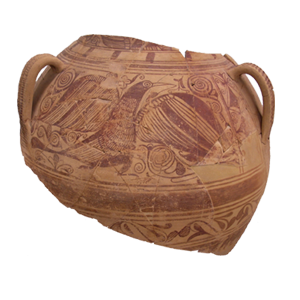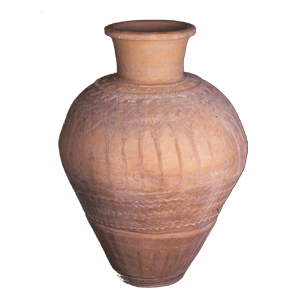

Elche-Archena style decorated jar
Tossal de la Cala (Finestrat).
Ceramics
h: 39 cm; a: 46 cm; e: 30 cm
Iberian
2nd-1st century BC
Part of a large ceramic vessel whose complete profile can be reconstructed from the number of handles and their asymmetrical arrangement. This arrangement indicates that the vessel would have had three handles, of which only two remain, and therefore corresponds to a well documented vessel in the late Iberian phase vascular repertoire, known as a pithoid jug. It is a large, closed container vessel with a concave base, globular body, neck and moulded lip; the handles, with a triple ribbon and vertical placement, are located in the upper half of the vessel. The exact function of this type of vessel is unknown. It has a monochrome painted decoration with a figurative theme that would occupy the entire vessel, known as the Elche-Archena style or symbolic style.
The pictorial composition is characteristic of the Elche-Archena style. On the one hand, we have the main and widest frieze occupying the noble part of the vessel, the upper half, where the handles act as dividers of the scenes in the manner of triglyphs; in this frieze the scenes with the most important content are developed. On the other, the secondary friezes, located in the lower half, for which vegetal and/or geometric themes are chosen. All the friezes are framed by fillets and wider bands. Another characteristic is the horror vacui, i.e. the absence of undecorated empty spaces.
The main frieze would have been composed of three scenes. In the only one that has survived in its entirety, the very characteristic motif of the bird with its wings outstretched has been chosen. Between the bird's head and the left wing is a winged rosette symbolising the Great Goddess. Of the scene on the left, only part of the head of an animal has survived, the arrangement, features and size of which indicate a butcher's prothorax with its head turned backwards. The scene on the right shows two animals on the run: the upper one, a butcher, and the lower one, a deer; above the butcher, part of a wing is preserved, which must correspond to a bird's prothorax on the animal's back; the space below is occupied by two small birds with wings outstretched and another butcher stalking one of them. The empty spaces in the three paintings are filled with the same repeated plant motif: a reticulated flower or leaf bud emerging from a spiral. A band of thick vertical lines separates the body from the neck, where there is another frieze of bird protomes with spread wings.
C.S.: 5715
NORDSTRÖM, S., 1973.
RAMOS FOLQUÉS, A., 1990.
SALA SELLÉS, F., 1992
Highlights of the Middle Ages Room
- DECORATED JAR
ELCHE-ARCHENA STYLE
Tossal de la Cala (Finestrat).
Ceramics
h: 39 cm; a: 46 cm; e: 30 cm
Iberian
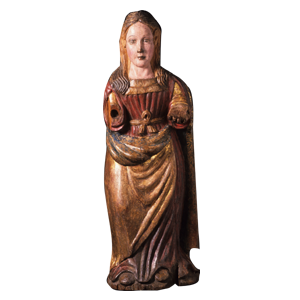
2nd-1st century BC - ................................................. Fondo Histórico MARQ Carving on wood and polychrome on canvas covered with a layer of plaster h: 94.5 cm; w: 30 cm; d: 23 cm: 30 cm; w: 23 cm Late Gothic First half of the 16th century
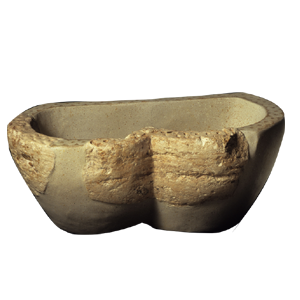
- ................................................. Castell d'Ambra, (Pego) Travertine marble h: 35.8 cm; w: 20 cm; h: 18.5 cm Of Islamic origin and Christian reuse 1250-1280
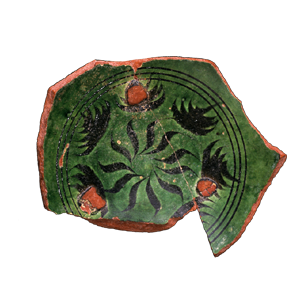
- ................................................. Rambla Méndez Nuñez (Alicante) Ceramic h: 16.3 cm; w. 4.4 cm: 4,4 cm Italian import End of the 15th century - Beginning of the 16th century
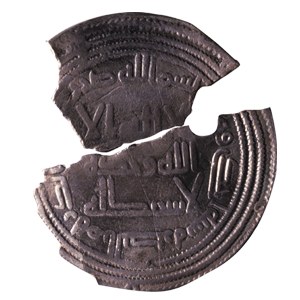
- ................................................. Finca "La Marquesa" (Almoradí) Caliphate Silver Mid-11th century AD.
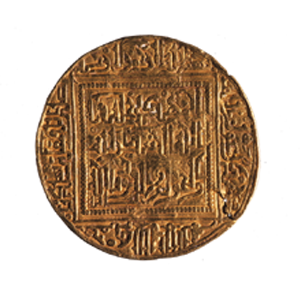
- ................................................. Numismatic Fund MARQ Gold d: 2'8 cm; p: 4'65 gr; p.c.:12 h. Medieval Islamic Hafsid. Tunisia 1249-1277
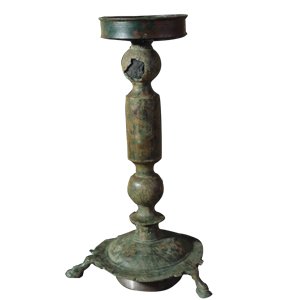
- ................................................ C/ Historiador Palau, Denia Bronze h: 47'5 cm; d: 26 cm Fatimid Islamic 11th century
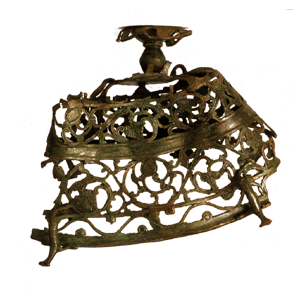
- ................................................. C/ Historiador Palau, Denia Bronze h: 21 cm; w: 26 cm; Fatimid Islamic 2nd ½ c. 10th c.
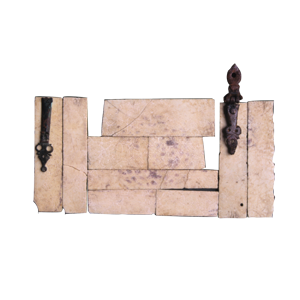
- ................................................. Torre Grossa Castle (Jijona) Reconstructed chest with bone plates and metal ornaments h: 26 cm; w: 11 cm; d: 10 cm (restored) Islamic Almohad Late 12th century, first half of the 13th century