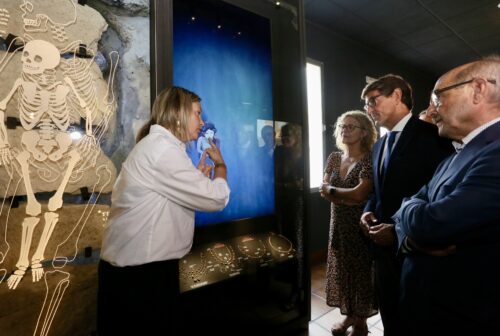
The deputy for Culture inaugurates the exhibition 'Trousseaus for eternity', which can now be visited at the Archaeological and Palaeontological Museum of the municipality.
The Archaeological and Palaeontological Museum of Rojales will definitively host the MARQ exhibition. "Ajuares para la eternidad. The funerary rite at Cabezo del Molino". with four sets of Byzantine jewellery found in the necropolis of Cabezo del Molino site of the locality.
The Deputy for Culture, Juan de Dios Navarroinaugurated the exhibition this morning together with the mayor of the town, Antonio Pérezthe director of the Archaeological Museum of Alicante, Manuel Olcinathe managing director of the Fundación CV MARQ, José Alberto Cortésthe Councillor for Culture of Rojales, Inmaculada Chazarraand the archaeologist and exhibitions technician of the MARQ Foundation, Mª Teresa Ximénez de Embún.
As Navarro explained, "This proposal stems from the results obtained in the research work carried out since 2018 at the Cabezo del Molino enclave, a project that is part of the Annual Excavations Plan of the Provincial Council of Alicante, through the MARQ, with the collaboration from the beginning of the Rojales Town Council and the Archaeological and Palaeontological Museum of this town.".
Through an innovative museography, explanatory panels and a narrative video, 'Trousseaus for eternity' shows a particular moment in history. The Cabezo del Molino is one of the first sites in the province where it has been possible to confirm the presence of Byzantine-era population (6th-7th centuries AD), in this case through a large necropolis which is also one of the first examples in our territory of Christian communities in the rural world.
The excavations revealed a large number of children's burials The remains found - probably victims of the serious epidemic known as the "plague of Justinian" - and the location of a group of female graves of very young ages - between 6 and 12 years old - who were treated in a very special way in the face of death. These girls died a sudden and premature death that prevented them from performing rituals of great social relevance, such as marriage, during their lifetime.
For this reason, at their death, and with the utmost care, they were dressed in a special way, with bridal jewellery. In these cases, as Ximénez de Embún explained, "in these cases, thehe documented funeral rite is impressive and moving, and has left us with a set of consisting of necklaces and earrings, made of high quality raw materials such as amber, bronze and silver, vitreous paste or semi-precious stones such as carnelian and turquoise.".
On the other hand, the last campaign of the Excavation Plan at the site concluded with important findings and new developments. The remains uncovered show a building whose floor plan and typology resemble those of the early Christian basilicas (comparable in size to modern-day hermitages). This finding, of great relevance for the scientific world, could mean the documentation, for the first time, of a complete funerary complex that would include two burial areas and an associated religious building.. Furthermore, the age of the funerary complex adds a special value to it, as it could be one of the oldest basilicas or religious buildings of a rural nature in the province of Alicante.