
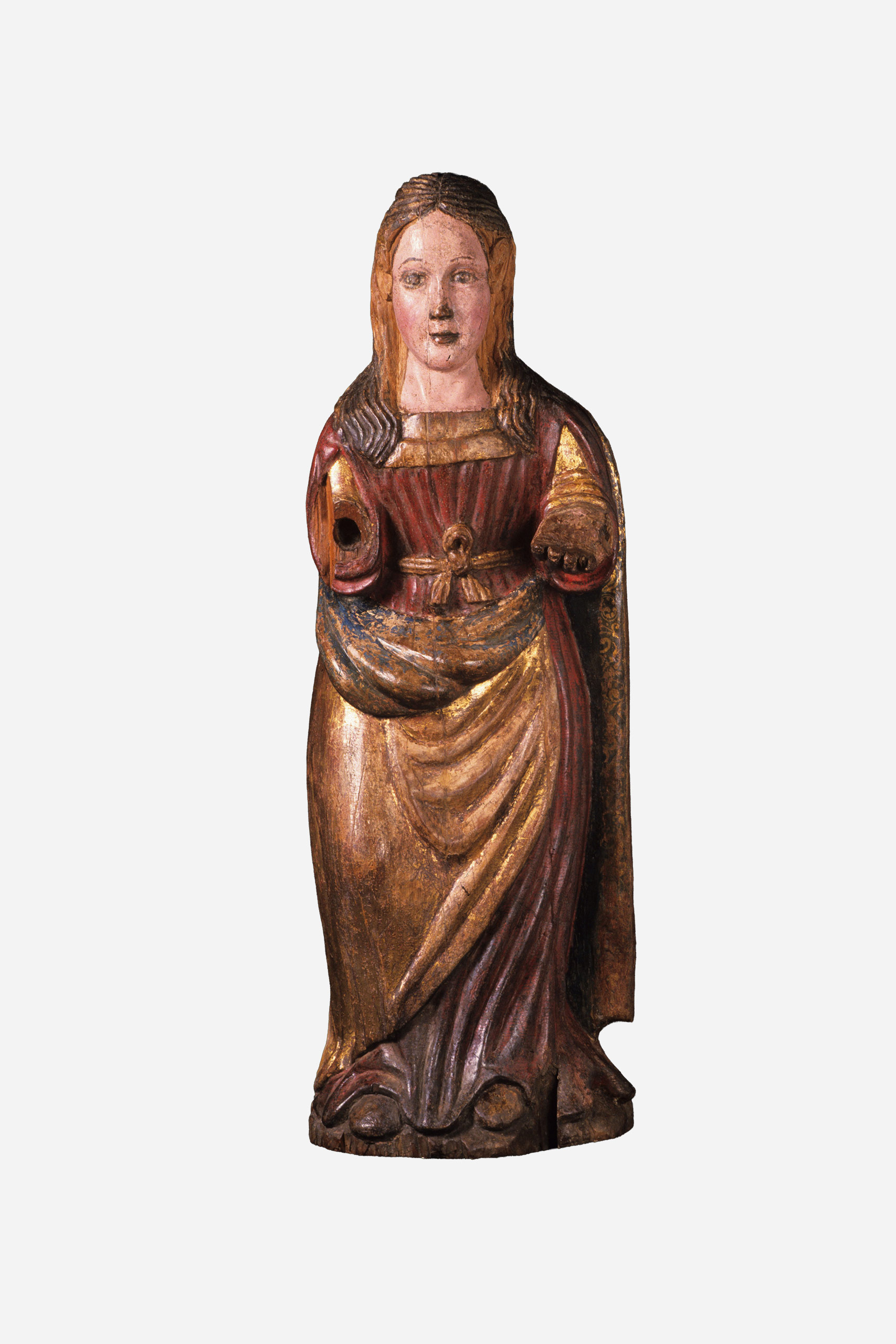
VERGE DEL ROSER
Polychrome wood Dénia
Church of La Vila. MARQ Castle.
Fondo Histórico by an anonymous artist, this sculpture of the Verge del Roser, made of carved and polychromed wood, is a notable example of Valencian religious sculpture. The piece has an elaborate polychromy applied on canvas, which covers a layer of plaster, a common technique of the time to achieve a more realistic finish. The image, now mutilated, does not retain the right arm or part of the left hand, where it originally held the attributes that identify its dedication: a rosary, Jesus and a bouquet of flowers. The crown, a common element in Marian representations, is also missing. Despite these losses, the sculpture still retains a remarkable expressive power and its original polychrome. The work was located in the Roser chapel inside the church of the Assumption of Dénia, located in the Vila Vella (Old Town). The iconographic type of the Verge del Roser, virgin with child and several attributes in the other hand, is maintained with variations from the 13th/14th century to the 16th century, as we can see in some parallels such as the Verge del Miracle (Cathedral Museum of Valencia), the Verge del Mar of Benicarló, the Mare de Déu del Rebollet (Oliva) or the Mare de Déu de Corbera.
In a more Renaissance style, we would have the Virgin and Child in the church of San Sebastián in Valencia. The attributes of these images are slightly different to those of ours, due to the evolution and change in religious and artistic sensitivity in the 16th century, as a result of the political, artistic and religious changes at the end of the Middle Ages. Throughout the Modern Age, many churches in the Crown of Aragon erected altarpieces in honour of the Virgin of the Rosary. In the 1930s, the Provincial Monuments Commission tried to protect it from anti-clerical acts and so it was moved to Alicante, where it remains on display today. The Verge del Roser is an outstanding example of 16th century Valencian religious sculpture and a testimony of the popular devotion and historical events that have marked the history of Dénia.
Chronology. First half of the 16th century. Dimensions. Height: 94.50 cm. Width: 30.00 cm. Thickness: 23 cm. Gisbert 1992; Menéndez 2007.
JAAD