NEPTUNE
Bronze
Dianium. Hort de Morand
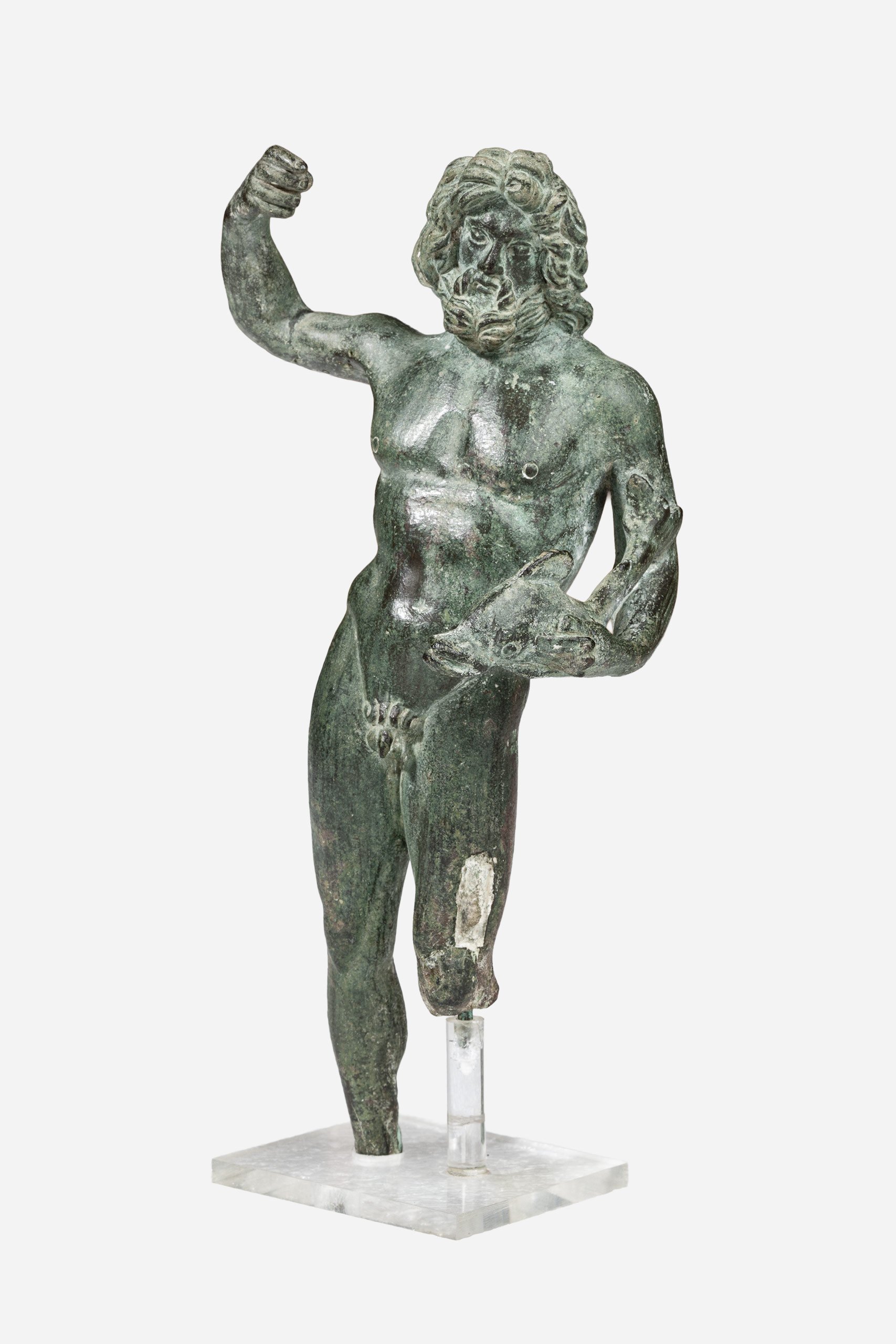
It was found in 1872 during the excavations carried out by the owner of the estate, José Antonio Morand y Fourrat (1820-1893) and entered the Museum of Fine Arts in Valencia in 1904, where it is kept today. It is a round-bodied figure, its left leg has been amputated at the knee, its right foot is missing and there is significant erosion on the left thigh. The god is shown standing naked, resting on his right leg, holding a dolphin in his left hand and with his right arm raised in an attitude of holding the trident. The body is muscular but proportionate, with well-defined anatomical features. The head is tilted slightly to the left and is covered with long hair that falls to the nape of the neck; it also has a dense beard. The pupils are incised. The work is meticulous and the figure has a restrained dynamism in which the hair alone evokes the forces of nature that the god personifies. Although it is normal for the figure to rest on his right leg, it is not common for him to raise his right arm, as it is usually the right arm that is raised and the right arm that is advanced. The figure has a marked musculature that appears in the representations of Olympian gods from the 5th century BC, especially Zeus and Poseidon. The Neptune of Denia reproduces on a reduced scale and in bronze an ivory sculptural type, the Ince Blundel, in which the god is represented naked, to which the mantle and the dolphin of reduced proportions in the right hand are added in the Guelma type. It belongs to the Sparta variant of these groups. As for its function, it may have been ornamental, perhaps in a garden. Chronology. 2nd century.
Dimensions. Preserved height: 22.00 cm.
Chabàs 1874; Poulsen 1933; García y Bellido 1949; Martín 1970; Balil 1975; Llobregat, 1980; Abad 1987; Rodà 1990; Alejos 1991; Simon i Bauchhenss 1994; Klöckner 1997; Arasa 2008. FAG