
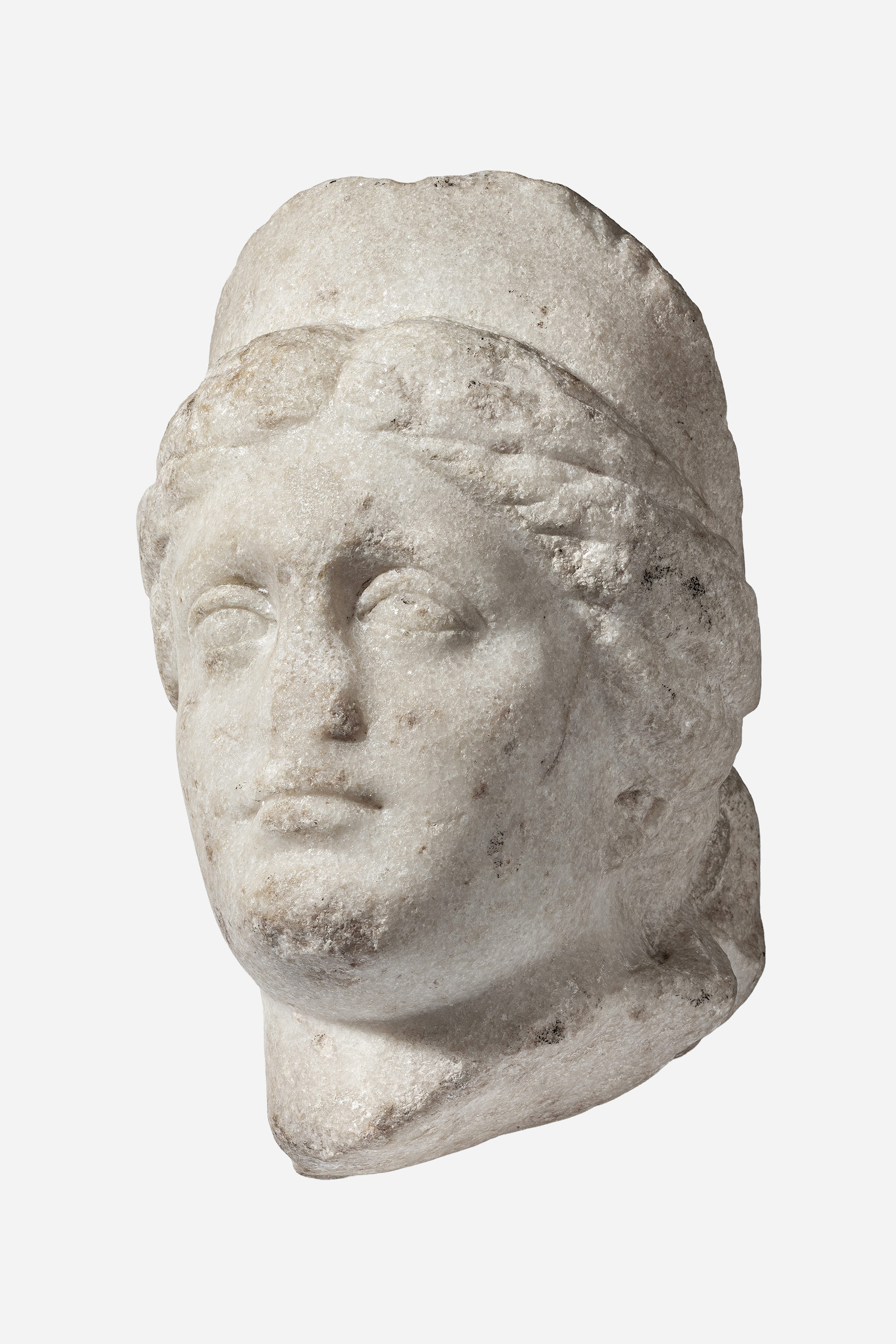
FEMALE HEAD WITH HEADBAND
Dianium white marble. Territorium
Estate of Tomás Mulet. Partida Pont Sec
Considered missing for many years, it was acquired by the Archaeological Museum of Denia in 2002, where it is currently kept. It is initially described by Chabàs, who published an engraving: "Greek marble head, the best of those found, if not for the cleanliness of the execution, for the correctness of the drawing; its simple hairstyle reveals the sculptor's great taste". It has some stains and traces of a reddish patina. It is diagonally fractured at the neck and has a broken nose, a blow on the left side of the tail, an eroded chin and several superficial scratches. On the right side there are two drill holes in the ear and at the point where the tail meets the base of the braid. It depicts a young woman with soft facial features wearing a centre-parted hairstyle and a plain headband with thick braids on either side, which are joined at the back in a knot from which a wide tail swings forward on the right side of the neck. The top of the head is barely outlined. The eyes are well marked, with two small drill holes in the tear troughs. The lines where the braids and the face meet, the headband on the inside and outside, the chin and the neck are outlined. The mouth is short and closed, with two dimples at the ends. The chin protrudes slightly.
From its dimensions, it would have proportions close to half life-size. In the first study of the piece, Balil identified her with the empress Lívia because of her facial features and the "classicist" type of hairstyle, but her recovery allows this interpretation to be discarded. The type of hairstyle with a diadem appears in Greek sculpture from the Classical period and was reproduced with various variants in the Roman period throughout the 1st and 2nd centuries, when it is frequently found on certain divinities, particularly in different types of representations of Aphrodite and Diana. As it is a small figure, it probably belonged to the private sphere, where it could have decorated the peristyle of a villa.
Chronology. 2nd century.
Dimensions. Height: 22,00 cm. Width: 13,00 cm. Thickness: 15,50 cm. Height of the face: 13,00 cm. Chabàs 1874; Martín 1970; Balil 1988; Gisbert 2009; Arasa 2013. FAG