- Around thirty volunteers are taking part in this edition, which will run from August to October and is coordinated by the Museum's director, Manuel Olcina.
The MARQ will launch, for yet another year, the Plan for archaeological excavations and investigations at six enclaves of the province. An initiative that contributes to the increase and preservation of the historical and cultural heritage and which has increased its budget by almost thirty thousand euros to 140,000 euros.
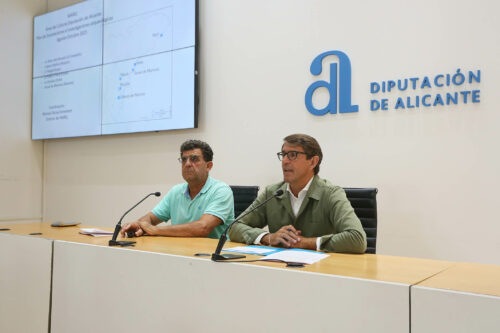
The Deputy for Culture, Juan de Dios NavarroThis morning, he presented the details of this campaign accompanied by the director of the Museum, Manuel Olcinaand stated that "The Diputación remains firmly committed to archaeological research through this extensive programme at half a dozen sites, located in the north, south and centre of the province, which cover periods from prehistoric times to the late Middle Ages and provide us with excellent tools to delve deeper into our past as a territory and learn about our history.".
Coordinated by Olcina , the plan has the collaboration of some thirty volunteers and fulfils the objective of documenting and carrying out a extensive scientific research of the findingsand to advance our understanding of the ancient civilisations that populated different enclaves of the territory.
Illeta dels Banyets in El Campello. Iberian Period (4th-3rd c. BC)
Located in El Campello, this site has been occupied for a long time, from prehistoric times to the Roman period. In this third edition, the objective will be to conclude the excavation of the first of the construction modules located next to the courtyard of the Lagar de la casa del Cura, reaching the pavement level to try to clarify its functionality and find out the reasons for its traumatic destruction. Under the direction of Olcina and Adoración MartínezThe work will last four weeks and will have a budget of 25,000 euros.
Cabezo Molino de Rojales. Hermiral period (8th-9th centuries)
This enclave spans from Late Antiquity to the beginning of the Middle Ages, from the Islamic period (6th to 9th centuries), and this year will continue with the field excavation work already begun, especially to delimit the burial area, as well as to document the possible presence of a building in the area surrounding the site. Under the direction of Juan Antonio López Padilla and Teresa Ximenez de Embún19,000 euros will be spent over a period of 25 days.
The Tabayà of Aspe. Prehistory, Argar culture
This important site of the Argar culture (second millennium BC) is a village built on a rough elevation that was probably a watch and control post on the course of the Vinalopó. The team led by López Padilla will work for five weeks to try to find out more about the cultural characteristics of this prehistoric period. The project has a budget of 25,000 euros.
Tossal de Manises in Alicante. Roman period (1st century AD).
For the year 2025, archaeological excavations are planned to resume at the Tossal de Manises, initiating a new General Plan of Action in accordance with the current legal regulations with a budget of 25,000 euros. The area chosen for the intervention is located in the centre of the site, next to the forensic space and the aim of this campaign is to deepen the understanding of the process of abandonment of the Roman municipality of Lucentum; to define the functionality of the large construction attached to the Roman forensic space, since it is accessed from it by descending in height; to discover the plan of the structures that defined the layout of Popilio Street when the town was founded, which, together with the forum, formed the architectural germ of the new city; and, finally, to gain an in-depth knowledge of the urban fabric of the Punic city of Ákra Leuké.
The Alcudia of Elche. Iberian and Roman city
With an important Iberian occupation, on top of which a Roman colony was built, with the population surviving until the beginning of the Middle Ages, La Alcudia is one of the most important archaeological sites in Spain. The intervention will mainly consist of the conservation and stabilisation of the structures analysed over the past year. The structures are in an advanced state of degradation with a danger of collapse of walls and pavements and this action will be the beginning of the definitive recovery of this important building of the Roman Ilici. Under the direction of Olcina, Rafael Pérez (Department of Architecture of the Provincial Council), Ana Ronda and Mercedes Tendero (Fundación Universitaria La Alcudia de Investigación Arqueológica, FUAIA, dependent on the University of Alicante), the work will last for five weeks and will have a budget of 21,000 euros.
Pobla d'Ifac de Calp. Late medieval period (14th century).
The twentieth excavation of this site will continue with Building XIV, a structure outside the city walls that is annexed to the western entrance to La Pobla. Completing the excavation of this building and documenting its function will be the main objective of the campaign directed by José Luis Menendez Fueyo which will last throughout the month of August and has a budget of 25,000 euros. On the other hand, the possibility is being considered of carrying out a partial mechanical removal, with archaeological monitoring of the earth, rubble and construction material of the old Palace Ifach hotel located in the eastern sector of the site, which until now has prevented access to the archaeological levels with a view to future research and to preparing the intervention areas for their enhancement.