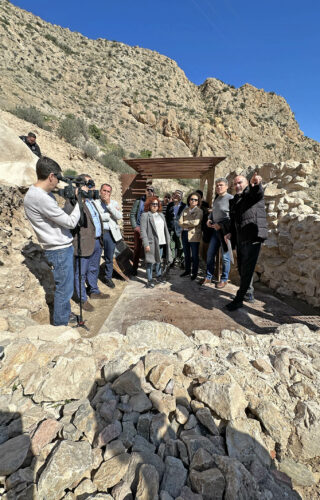
The Member of Parliament for Architecture, Carmen Sellésthis morning visited the site at Slopes of the Castle of Callosa de Segura to inaugurate the archaeological site after consolidation, rehabilitation and enhancement works. 450,000 subsidised by the provincial institution with 450,000 euros..
Accompanied by the Deputy for Infrastructures, Antonio Bernabeuand the local mayoress, Amparo SerranoSellés toured the area together with the director of MARQ, Manuel Olcina and the director of the Architecture Department of the Provincial Council, Rafael Pérez. "Our job as a provincial institution is to stand by the municipalities and support their work, their investments and their projects to consolidate and promote the rich architectural and cultural legacy that we treasure in our territory and, in this case, we are dealing with one of the most exceptional sites in the Vega Baja."said the MEP.
The Diputación has subsidised the 90 percent of the projectThe aim of the project was to establish the safety conditions for its opening to the public, in a complete action that includes urban remodelling in the area of access to the enclave, hydraulic regulation for its protection, the adaptation of the itineraries, excavations, consolidation and rehabilitation of the structures brought to light in the archaeological interventions and the supporting museographic elements.
The Laderas del Castillo site is chronologically framed within the Argaric culture, which mainly covers the southeast of the Iberian Peninsula. The first archaeological interventions date back to 1907-1908, carried out by the Jesuit Julio Furgús on the western slopes of the Sierra de Callosa, and in 1924-1925, the Catalan archaeologist Josep Colominas on the eastern slope. These and other researchers brought the first findings to light, connecting them with other archaeological sites in the territory.
In 2012, the site was extensively surveyed in order to sectorise it and plan its excavation within the framework of the research project "El Proceso Histórico en el III y el II milenio ANE en el Bajo Segura y Bajo Vinalopó", promoted by the Diputación through the MARQ. The archaeological campaigns carried out between 2013 and 2021 have been directed by the archaeologists Juan Antonio López Padilla and Francisco Javier Jover MaestreThis site, with an extension of more than two hectares, is one of the most significant Argaric enclaves, as it allows us to characterise the beginnings of the Bronze Age in the province and to explain the beginning and development of the Argaric culture in its northernmost area.