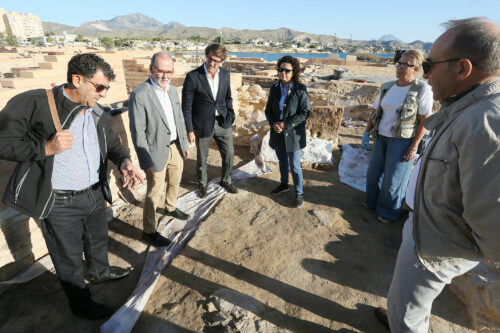
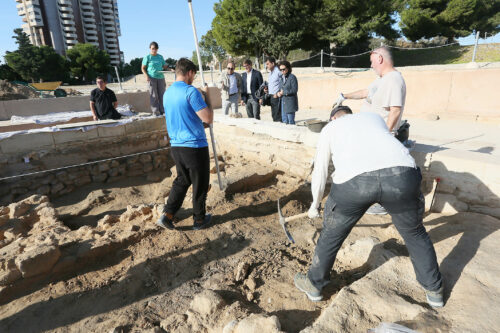
Architecture and Culture MEPs, Carmen Sellés and Juan de Dios NavarroThis morning they toured the site together with the mayor of El Campello, Juanjo Berenguerthe director of MARQ, Manuel Olcinaand the director of the Architecture Department, Rafael Pérezto check in situ the progress of the latest campaign of the MARQ's annual excavation plan.
Until now, at the site of El Campello, only the religious centresrepresented by the two temples, and the productive spaces The site was also known for its wine presses, oil mills, pitch ovens, esparto grass workshops, warehouses and facilities for salting fish, but only one building was known to have been used to house the inhabitants of the enclave.
"The identification of this new space is a great step forward, as it will allow us to learn a little more about the daily life of the people who inhabited the Illeta and to continue working on research into the history of our province."said the deputy. For her part, Carmen Sellés stated that the consolidation of architectural structures so that visitors to the site can enjoy the new spaces and thus expand the museum offer.
The identified building has undergone many alterations, fires and extensions. The rammed-earth floors of the rooms were repeatedly resurfaced, and in one of them the remains of the footwear made of esparto grass that is just under 2,300 years old. "It is not easy for organic matter to be preserved, hence the importance of this find, which directly shows us one of the foot protection elements used in the first half of the 3rd century BC and which has survived with few variations up to the present day."Olcina explained.
In addition, some of the furniture in the flats was identified, consisting of adobe benches and a home which had been in continuous use for a long time, with several refraction operations that slightly modified its appearance. It has also been possible to locate some of the domestic crockery, mostly of foreign origin, such as the jug, the Punic black and red-glazed saucers and potsherds made in the Carthage area, amphorae and jugs from the Punic-Ebusitan area, small stamped potsherds, and some Iberian ceramic pots and painted ceramic plates of the same production.
In addition, the 2025 campaign is now coming to an end in the Tossal de ManisesThe first of a four-year project to excavate the large building annexed to the forum and to reach the foundational strata of the inhabited space, dating from the end of the 3rd century BC, was the first of a four-year project to excavate the large building annexed to the forum and to reach the foundational strata of the inhabited space, dating from the end of the 3rd century BC.
The building is a large rectangular structure measuring 10'20 by 19 metres, the functionality of which is unknown as there are no elements that could define it. The removal of the first layers of earth revealed a series of square and rectangular structures, partially affected by the fire. As Olcina explained, "Chronologically, they predate the Augustan period, i.e. before the establishment of the Empire at the end of the 1st century BC.".
Some characteristics suggest that it could be part of the first city founded by Amilcar BarcaAkra Leuké at the end of the 3rd century BC, which was destroyed by the Romans during the Second Punic War. "If this is confirmed, we would have at the end of the project a huge area of 196 m2 in which this Punic city, with its buildings and streets, would be clearly visualised, something exceptional in the archaeology of Spain."concluded the MEP.