The discovery, of great importance for the scientific world, is part of what is considered to be the largest Byzantine necropolis in the Iberian Peninsula.
The deputy for Culture and the director of the museum present the details of the work carried out this summer and emphasise the institution's firm commitment to archaeological research.
The eighth campaign of the MARQ Excavation Plan at the site of the Cabezo del Molino de Rojalescarried out during the first three weeks of September, has concluded with important discoveries and novelties, among which the location of what could be one of the most important the oldest religious buildings of rural character in the province of Alicante.
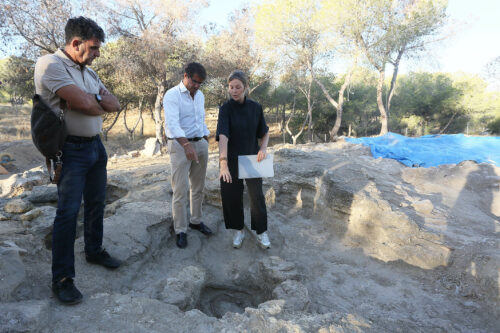
The Deputy for Culture, Juan de Dios NavarroThis morning, he visited this archaeological site, known for its important results in the research of the Byzantine period. In fact, it has become an international reference point following the location of a necropolis and the innovative studies carried out and related to the anthropological and palaeopathological analysis of human remains or its complex genetic study in collaboration with the German Max Plank Institute.
Directed since 2018 by Teresa Ximénez de Embún and Juan Antonio López PadillaThe great novelty of this year's excavations has been the discovery of the remains of a building whose plan and typology are similar to those of the early Christian basilicas (comparable in size to modern-day hermitages). This finding, of great relevance for the scientific world, could mean the documentation, for the first time, of a complete funerary complex that would include two burial areas and an associated religious building.. Furthermore, the age of the funerary complex adds a special value to it, as it could be one of the oldest basilicas or religious buildings of a rural nature in the province of Alicante.
Accompanied by the director of MARQ, Manuel Olcinaand Ximénez de Embún, Navarro, stressed the importance of this new discovery and said that "... the new discovery is a new discovery, but it is not a new one".The Diputación remains firmly committed to archaeological research through this extensive programme with the aim of documenting and carrying out a wide-ranging scientific investigation of the findings, as well as advancing knowledge of the ancient civilisations that populated this territory.".