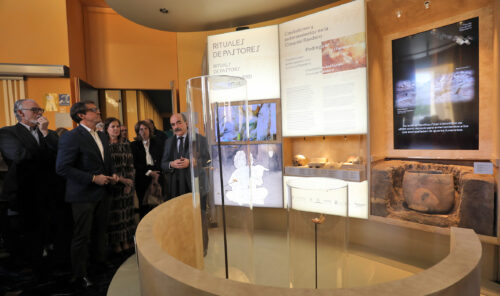
The Archaeological Museum of Alicante inaugurated this morning an exhibition of the research carried out at the Cova del Randero of Pedreguer. Shepherds' Rituals will show for a few months in the museum's hall the results of the excavations that confirmed the first finding of ritual cannibalism in the Levante Peninsular in the Neolithic context.
The Deputy for Culture, Juan de Dios Navarropresented the new proposal together with the mayor of Pedreguer, Sergi Ferrúsas well as the regional director of Alicante-Centre of Banco Sabadell, Ana Ponsodathe director of MARQ, Manuel Olcina, the managing director of the Fundación CV MARQ, Josep Albert Cortésand the curators of the exhibition, Consuelo Roca de Togores and Jorge A. Solerdirector of the MUBAG.
Navarro thanked the work and research of the team of experts, volunteers and professionals who have collaborated during more than a decade of excavations, between 2007 and 2021The exhibition is part of the Cova del Randero Archaeological Excavation Project, promoted by the Diputación de Alicante in close collaboration with the Pedreguer Town Council. The exhibition includes a set of arrowheads, a skull used as a relic, a vessel and the remains of a child's jawbone, all of which are evidence of the first finding of ritual cannibalism Neolithic period in the Levantine area.
These advances have made the enclave one of the most important sites in the east of the Iberian Peninsula to study the cave dwellings of the Middle Neolithic (between 4500 and 4000 BC), as well as the funerary aspect of the Final Neolithic-Chalcolithic (between 3500 and 2700 BC), allowing us to reconstruct the way of life of the human groups that practised a production economy, cultivated cereals and tended herds..
As the commissioners explained, there are two phases. On the one hand, the Middle NeolithicThe site was used as a shelter by small groups of shepherds to protect their livestock, adapting the cave spaces to their needs, separating the livestock: the outermost area for adults and the central gallery for pregnant females and newborns, guaranteeing reproduction and milk production, while the innermost area was used for the shepherds' rest and to process the animals' meat. In this inner area, a pit was found with a large ceramic vessel which was used for cooking, perfuming the atmosphere by heating aromatic plants, and acting as a fire deposit for lighting.
Within the framework of the second phase, in the Late Neolithic-Chalcolithichuman skeletal remains have been documented, confirming the use of the site as a burial space. One of the most outstanding finds is the complete skull of a male between 35 and 45 years of agelocated in the innermost gallery of the cave. It was found isolated, in an unusual arrangement, protected by stones, and its dating (3400 BC) places it approximately four centuries before the rest of the burials. The identification of enclosing elements in two internal areas of the cave allowed for the exceptional preservation of objects linked to the adornment of the deceased and the grave goods that accompanied the funerary rituals. These include necklace beads, pendants, axes, adzes, flint knives, ceramic vessels and an excellent set of 17 flint arrowheads.
Finally, and related to livestock use in the Middle Neolithic, the skeletal remains of two children were found, one approximately 7-8 years old and the other a newborn. Their study revealed various marks on the surface of the bones, such as cuts made with flint tools, fractures for the extraction of the marrow and human bites. These marks are evidence of a particular treatment of the bodies after death, suggesting the practice of cannibalism as a funeral rite linked to mourning. This act could have been a way of expressing an affectionate gesture, an acknowledgement of the connection with a loved or close one, whose bond one wished to preserve.