The exhibition, inaugurated in Madrid by the deputy of Culture, the undersecretary of the Ministry of Culture and the director of MAN, will be open until January.
The MARQ inaugurated this morning at the National Archaeological Museum of Madrid the exhibition The Carpathian Princess".an exceptional set more than 4,000 years old found in an Argaric burial site in San Antón (Orihuela).
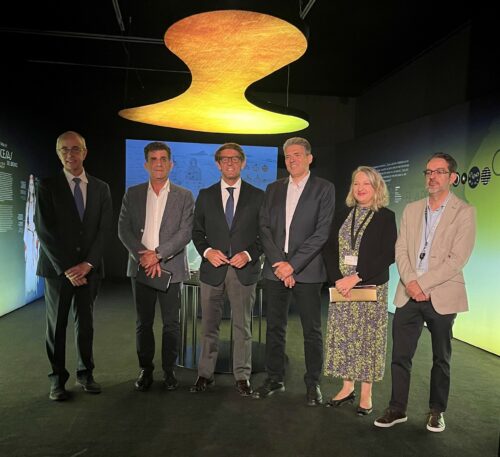
The Deputy for Culture, Juan de Dios Navarropresented the exhibition together with the undersecretary of the Ministry of Culture, Carmen Paezthe director of MAN, Isabel Izquierdothe director of MARQ, Manuel Olcinaand the MARQ archaeologist and curator of the exhibition, Juan Antonio López Padilla.
"For the Diputación de Alicante it is a great satisfaction to exhibit this exhibition at the MAN and to offer a unique opportunity to admire a Bronze Age grave goods and to learn about its extraordinary history thanks to the long research work carried out by the team of archaeologists and technicians of the MARQ."said Navarro, who recalled the important line of collaboration that has been established between the two museums.
Until 25 January 2026the Sala de Novedades Arqueológicas located in the MAN foyer will host the exhibition which includes a ceramic vase, a knife and a metal awl with bone handle, two silver spirals and 42 gold conesfrom a Bronze Age burial from the site of San Antón in Orihuela, as well as three gold hair scrunchies and four gold rings from the same site. All of them belong to the permanent collection of the Diputación de Alicante, which is kept at MARQ.
It is a set of pieces from the Bronze Age, more than 4,000 years oldfound in Orihuela more than a century ago by Jesuit Julio Furgús in a grave belonging to the so-called culture of El Argar. The woman lying in that tomb was adorned with two silver spirals, a copper knife wrapped in a linen handkerchief, a metal awl, as well as a handmade ceramic vessel placed in front of her head, and a set of 75 tiny gold cones perforated, barely 3 millimetres thick, at the level of her neck.
As Olcina has explained, ".these tiny gold cones are unique, as nothing similar has yet been found in the context of the Peninsular Bronze Age, and research points to Eastern Europe where, around the Carpathian Basin and at a time contemporary with the culture of El Argar, identical pieces were made and sewn into cloth.".
Recent studies have shown that in Argaric society, like many others in Bronze Age Europe, women left their villages of origin to marry. In the case of the elites, it was these marriage exchanges that made it possible to forge international business alliances with families of the same social statusbut from other parts of Europe and the Mediterranean.
This discovery is the result of arduous work on the Bronze Age in general, and on the society of El Argar in particular, which has been carried out for more than fifteen years by the MARQ, with the support of the Provincial Council. The work, headed by López Padilla, has been carried out with the participation of the Professor of Prehistory Francisco Javier Jover and specialists from the University of Alicante, Ricardo E. Basso and María Pastor.