The exhibition has the collaboration of entities such as the Cathedral Museum, the Fine Arts Museum and the Prehistory Museum of Valencia, the MAN in Madrid, the Louvre in Paris and the Bancaja Foundation.
Dénia, archaeology and museum'. is an exhibition promoted by the Diputació together with the Dénia Town Councilthrough the MARQ and MADMuseu Arqueològic de la Ciutat de Dénia. The exhibition has the collaboration of a dozen museums, archives and national and international foundations that have lent their pieces in order to facilitate the historical contextualisation of the city.
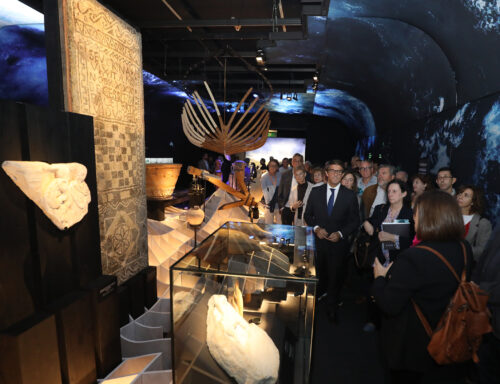
The Deputy for Culture, Juan de Dios Navarroaccompanied by the regional secretary for Culture, Pilar Tébarand the Mayor of Dénia, Vicent GrimaltThis morning, they inaugurated the exhibition comprising a careful selection of pieces of great historical value from the Dénia's patrimonial funds and other museums, which can be seen for the first time in Alicante until April 2026. Navarro highlighted the work of this "innovative project that once again places MARQ at the forefront with a novel presentation based on the duality of sea and land, essential and complementary elements that fill the history of Dénia and its territory with meaning.". The event was also attended by the managing director of the MARQ Foundation, José Alberto Cortésthe director of MARQ, Manuel Olcinaand the head of the Archaeology Department of Dénia and curator of the exhibition, Massu Sentí.
The route proposes from the manifestations of rock art in the Catxupa Caveto emblematic sites such as the Alt de Benimaquiaone of the oldest wine-growing centres on the Peninsula, or the founding of the Roman city of Dianiumtransformed into madīna DāniyaThe city of Dénia, an outstanding port in the Islamic Mediterranean, became the contemporary Dénia.
A llaüt welcomes you to the first room, which is dedicated to the the city's maritime vocationand advances the modern exhibition design carried out by the team from Angel Rocamora. From Protohistory and Classical Antiquity, the urban nucleus has materialised as the support of a port in constant and permanent dialogue with the sea, which makes it the epicentre of the events that have taken place in its territory throughout its long history.
The floor evokes a sea in movement in which objects are exhibited that are the product of the relationship that our past societies developed through their routes. Of particular note are the amphorae of wine and oil from all parts of Rome or the most important set of bronzes in the Islamic WestThe exhibition is the first time it has been brought together for the purpose of this exhibition. treasure and rich collections of medieval ceramics from sunken ships. Or the length sultana journey and the international relations that its trade brought about in the course of the 19th century.
The other axis of the city of Denia is its intense materiality, with a large number of objects that are an expression of its historical evolution, a corollary of more than forty years of the Urban Archaeology programme. Thus, in the second room you can contemplate the imposing port façade of DianiumThe city's territory was articulated through its territory, with numerous buildings and docks and the necropolis with its funerary offerings. Or the articulation of its territory by means of villae agricultural exploitation, with amphora production centres such as the one at l'Almadrava.
This room exhibits the material traces of the prodigious DāniyaA medina with commercial districts, a large and densely populated port suburb, and other suburbs with an artisan purpose, with an intense productive life expressed through more than twenty pottery kilns. And then, the medieval town, which in 1612 received the title of city from Philip III. These were the beginnings of an urban centre which, after experiencing the boom derived from the sultana trade throughout the 19th century, plunged into a crisis which it was able to turn into an opportunity with the development of a colourful toy industry.
Dénia, archaeology and museum' also brings together selected works on temporary loan from other museums, such as the MARQthe Valencia Cathedral Museumthe Fine Arts and Prehistory of the same city, the MAN Madridthe Louvre in Paris -with a epigraphed marble plaque of the 11th century Vizier Abu Amir Muhammad- or the Bancaja Foundationwith the canvas of Vicent Mestre The Embarkation of the Moors in Denia Portwhich is part of a series of seven that the, King Philip II of Valencia and III of Castile commissioned to fix in the historical memory a transcendental event for our land, the expulsion of the Moors between 1612 and 1613.