The congress has made visible the decisive role of wine in Alicante, claiming its place among the most important wine regions in the world.
The research on "Alicante 1510", presented during the Congress, justifies Alicante as the first Designation of Origin in the world.
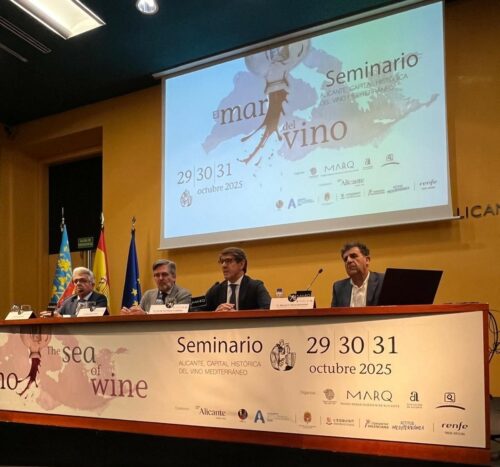
Looking to the past to face the challenges of the future. Under this premise, and within the framework of its gastronomic capital 2025, Alicante claims its extremely rich wine heritage through the international congress "Alicante, historical capital of wine in the Mediterranean"..
A true memory of wine that defends its deserved leading role over the centuries, both culturally and socio-economically, and which has been articulated in a powerful agenda of activities around wine that have turned the city, from 29 to 31 October, into its neuralgic and historical centre.
For three days, the MARQ, the Archaeological Museum of Alicante, served as a successful meeting point for the most important experts from the most diverse wine regions of the world. From Armenia, Egypt, Georgia, Italy, Germany, Hungary or France, to different parts of the Iberian Peninsula, they have extolled and made known to the more than a hundred attendees to the symposium, between the public in person and online, the ancient history of wine and all that it has meant and means for society. The presentations have been recorded and will be published soon.
The history of wine is being written in the Mediterranean
The Mediterranean is undoubtedly the sea of wine, a sea that brings together an unparalleled wealth and diversity on its shores. A natural flow of exchange across the Mare Nostrum that this congress has sought to replicate and enhance, being a meeting place to share knowledge and experiences, in order to define and face the challenges and opportunities of wine in the future, always based on research and training.
For two days, leading experts in the history and archaeology of wine shared their latest discoveries and their research, from those who, thanks to the collaboration of disciplines such as archaeology, biomolecular chemistry and genetics, are unravelling the origins of wine and how it spread from Caucasia to the Middle East and the Mediterranean basin, to the almost divine character with which it arose and which has always linked it to religion, These include those which, thanks to the collaboration of disciplines such as archaeology, biomolecular chemistry and genetics, are unravelling the origins of wine and how it spread from Caucasia to the Middle East and the Mediterranean basin, to the almost divine character with which it arose and which has always been linked to religion, ritual and magic and which, without doubt, is an essential part of the importance it has had in societies throughout the ages.
Thus, among many other discoveries, we were able to discover the oldest wine press in the world, found in Armenia, in the Areni-1 cave; learn more about the oldest bottled wine, the Speyer bottle; travel to Pompeii, where the oldest liquid red wine in the world has been discovered, or delve into the wine-archaeological wealth of the Carmona site (Seville). Local heritage was also present throughout the various presentations at the congress and at the welcome ceremony, which was held at the Illeta dels Banyets site in Campello, where there are wine presses from the Phoenician period.
An impressive past linked to wine that has lived on, century after century, throughout the province of Alicante, with the diversity and sustainability of its vineyards and its fondillons, unique wines that live beyond time; or those that have emerged after the recent research of "Alicante 1510" and that are the present expression of the history and values of the Mediterranean.
Historic tastings in sites steeped in history
The congress was complemented by a series of extraordinary tastings, given by some of the most important communicators in the world of wine, which took place in three emblematic places in the city: the Castle of Santa Bárbara, the Casa Mediterráneo and the Co-cathedral of San Nicolás.
The first of the tastings, which took place on 29 October, was given by the prestigious English Master of Wine Sarah Jane Evans, which, under the suggestive title of Tasting History and in the unbeatable setting of the halls of the Santa Bárbara castle, he made a liquid journey through the Mediterranean wines that are part of its history; classics made with varieties such as malvasia, muscatel, roditis, kisi, merwah taken to profoundly Mediterranean styles, with origins as different as Greece, Lebanon, Georgia, Armenia or Alicante. I have looked for wines with a very classic style, made with historic varieties or which represent a renewal in the area", Evans pointed out, "because it is very difficult to find wines like those made centuries ago: from wines in amphorae, to the recovery of styles as typically Mediterranean as retsina or sultana wines".
On Thursday 30 October, the day was dedicated to the Youth with History. Beth Willard (taster on the Tim Atkin MW team, judge and co-chair of the Decanter World Wine Awards) and María José HuertasThe two sommeliers, who have climbed the wine communication ladder since their work with Paco Roncero at the Casino de Madrid, chose Casa Mediterráneo to bring the vision that the new generations are bringing to the profiles of Mediterranean wine. The two great communicators, who had never before held a joint tasting, showed perfect harmony when it came to describing this journey through the "more modern side of the Mediterranean", in a commitment to modern wines, but with a foot in the past of their region, with which we travelled through countries as diverse as Bosnia and Herzegovina, Sicily, Georgia, Croatia... but also the Penedés, Mallorca and Alicante.
The final touch came on Friday 31 October, from the hand of Ferran Centelles (Drinks Manager of ElBulliFoundation) and Pedro Ballesteros MWThe two of today's best wine communicators, who, in the spectacular cloister of the co-cathedral of San Nicolás, searched for the essence and truth of Fondillón: In Fondillón, Veritas. Thus, Centelles and Ballesteros brought to light a selection of some of the jewels that are treasured in the most particular cellars of the Vinalopó wineries, resignifying all the "humanity" and symbolism of the Alicante Fondillones in a tasting that began with a private visit to the temple and a demonstration of the power of its 15th century organ. As Centelles pointed out, it was "a unique opportunity to taste almost all the fondillones that are produced in a single tasting", emphasising that fondillón is "a magical product, of which there is no other like it in the world, because it is an oxidative wine, something extremely rare, I would say a miracle; a wine of meditation, of complexity, and for this reason the Concathedral was the perfect place".
The event was also an opportunity to showcase the research on "Alicante 1510". which justify Alicante as the first Denomination of Origin in the world, thanks to "the existence of a delimited territory, a specific style of oenology and wines, a brand prestige since the 12th century (with registers, control measures and another series of protocols) that is two hundred years ahead of the dates of Oporto. This research was backed up by the detailed presentation of José Luis Menéndezdirector of the symposium and archaeologist and exhibition technician at MARQ.
"Alicante, historical capital of Mediterranean wine" has thus highlighted the incalculably rich past of Alicante wine, showing the brilliant moment of recovery of memory and respect that its wines are experiencing. A firm proposal of the DOP Wines Alicante that is shown as an essential tool to face all the challenges that the current moment holds, from the history, towards the future.