
Sanctuary of Pla de Petracos
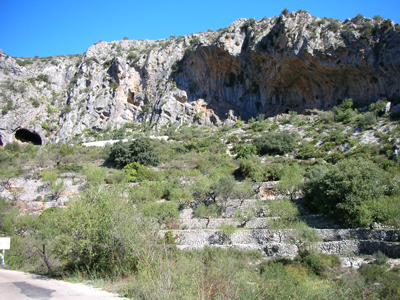
The Sanctuary of Pla de Petracos, located in the municipality of Castell de Castells, is one of the most outstanding examples of Macroesque Art in Europe and has been declared a Site of Cultural Interest and World Heritage Site. The importance of the site led the Provincial Council of Alacant to enhance its value by improving its dissemination, protection and access to the site, works that were inaugurated on 3rd March 1998.
The provincial institution of Alacant, through the Provincial Archaeological Museum (MARQ), is promoting a programme of Rutes d'Art Rupestre (Cave Art Routes) which, under the tutelage of the Autonomous Administration and with the collaboration of the municipality of Castell de Castells, aims to improve the protection of artistic manifestations, while at the same time encouraging the promotion of artistic manifestations;Administració Autonòmica and with the collaboration of the municipality of Castell de Castells, aims to improve the protection of the artistic manifestations, at the same time as promoting knowledge of them, facilitating access and installing explanatory panels.
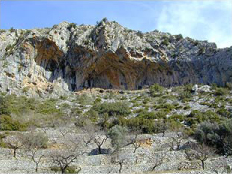
The Pla de Petracos site takes its name from the area where it is located. It is a set of caves and a cave located on the left bank of the Barranc de Malafí ravine, within a geographical area that is delimited by the sea and the mountains of Aitana, Mariola and Benicadell. Access to the site is via a track that starts at km 7 of the road from Benigembla to Castells de Castells, and connects the area where the site is located with the Terme de La Vall d'Ebo. The site is located at the geographical coordinates of 38º 45' 37" lat. N. and 0º 10' 59" long. W. Located at 485 m above sea level.
Discovered in 1980, it is made up of eight abrics, five of which have perfectly visible motifs painted in bright red. Of these, four, which are close to each other, conserve representations ascribed to the so-called Macroesquematic Art, a manifestation linked to the earliest Neolithic period, and the'another preserves part of'a representation of'Art Llevantí, a chronological manifestation later than the original Macroesquemàtic Art.
The representation of the human figure is its central theme, with the figure of the praying man standing with his arms stretched upwards. In front of it, a few metres from the rocky wall, a large stone stands out from the ground, which could be related to the meaning of the pictorial representations.
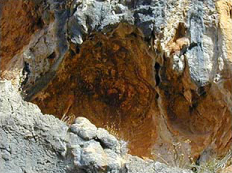
Alongside these figures, which sometimes form groups or pairs, there is an abundance of geometric motifs, particularly serpentine or meandering shapes made up of large, vertically unfurling, sinuous bands.
The Pla de Petracos is one of the best rock art sites in the Valencian Community. At the time when the paintings were made, it was a sanctuary: a meeting place and place of worship for people united by deep beliefs, in which fertility and fecundity, the agricultural cycle and family ties played a special role.
This sanctuary of'Macroeschematic Art, declared of Cultural Interest and World Heritage, is located in a splendid setting. Its visit is a magnificent opportunity to enjoy nature in a privileged setting. Nowadays, the sanctuary of Pla de Petracos is a regular place to visit and one of the most important tourist centres in this mountainous area of the inland part of the province of Alicante, which has generated great wealth for the municipalities in the area, such as Castell de Castells. The enhancement of the site allows us to enjoy, learn and understand the macro-schematic art with exceptionally important cultural equipment.
Visit the 360º view of this site