
PIECE OF THE MONTH. Decorated painting (fragment)

| DECORATED PAINT (FRAGMENT) Mola d'Agres Ivori
CS: 1683 Document number: MA/81-V-3
Cataloguing Office: Daniel Belmonte Mas (Date: 10/06/1998)
|
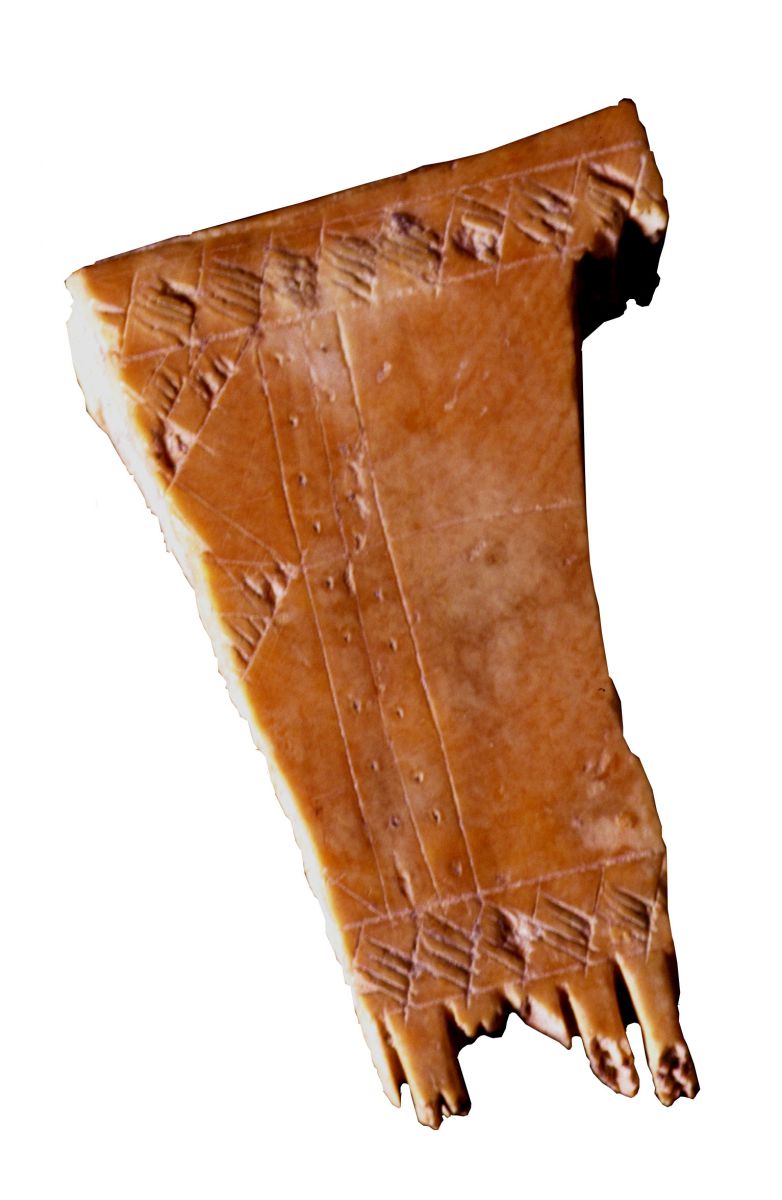
Fragment of a pinta, an element of personal painting, made using the techniques of carving and polishing on a thin rectangular-shaped and sectioned ivory plate. The lower part of the piece still retains the start of the stems, but most of the piece is missing. It has incised decoration on both sides with geometric motifs. The composition, which is the same on both sides, has two horizontal bands at the top and bottom. They are decorated with triangles that form lozenges filled with parallel lines. Two vertical lines filled with dots seem to frame the central composition, of which only the start of diagonal lines parallel to each other is preserved. Restored at MARQ in 2006 (FTR 253), the piece was cleaned, sanded and consolidated, as it showed signs of brutality and exfoliation. It is currently stable.
The fragment of paint, which is on display in the Prehistory Room of the permanent exhibition of the MARQ (PH-VITRINA 15), comes from the south-eastern terrace of the site of La Mola d'Agres, a sector of altered stratigraphy and where the material, characteristic of the Late Bronze Age/Ancient Iron Age, appears refined (Stratum: Layer 3, Sector: V, EMU: 11). This group includes several fragments of ivory, a scarce and difficult to find material: the pint, fragments of armlets and a large unworked defence wheel.
The abundance of ivory materials and objects that appear has led us to believe that there was a workshop for the production of artefacts made from this material, in operation during the Early Bronze Age. In the context of the enrichment of social elites and the exchange of materials and objects as well as aesthetic canons, the decorated paintings are a clear example of the development of the production of personal adornments on hard animal materials during the Bronze Age. Thus, the presence of the ivory workshop at Mola d'Agres indicates the existence in the area of a well-established elite that demanded prestigious adornments (Pascual Benito, 1995).
Ivory, documented only in the south-east of the Iberian Peninsula and in the Balearic Islands during the Bronze Age, arrived together with copper through a wide network of exchange circuits. At this time, there was a change in the routes and export points compared to previous periods. It seems to have stopped arriving via the Atlantic from Morocco: it now comes from the Orà area, enters from the south-east, among other points, and is redistributed through the nuclei of the northern area of the Argaric Culture. The ivory analysed is from elephants and Asian and African hippopotamuses.
Thus, the origin of the raw material used to make decorative objects is an example of the participation of the Mola d'Agres in a wide circuit of exchanges. The shape and decoration of some of the objects made in the workshop point in the same direction: the archaeological record of the Llevantine coast of the peninsula shows, during the second half of the 2nd millennium BC, imitations of the artefacts of elite consumption of the groups from the north of Italy, specifically from the Terramare of the Po Valley. This similarity is due to the existence of a wide circuit of inter-regional contacts with the central Mediterranean, prior to the Phoenician routes.
From the 16th century BC onwards, the elite took part in these circuits through a network of enclaves in the south-east of the peninsula controlled by the main settlements, such as Cabezo Redondo. This is the context in which the control of the circulation of ivory, which partly explains the great development of the northern areas of the Argaric territory.
In this sense, the local productions of the Mola d'Agres imitating the stylistic and morphological patterns of the Terramare are important: their late chronology (10th and 9th centuries BC) shows that the Vinalopó continued to be a route of diffusion integrated in this Mediterranean circuit until even after the abandonment of Cabezo Redondo, during the last third of the 2nd millennium BC (López Padilla, 2011).
La Mola d'Agres, where the ivory continues to arrive along the road that connects the Vinalopó with the Serpis, was during the Late Bronze Age a point of great geostrategic importance in the network of exchange and redistribution. Some very rich and unique artefacts have been recovered here, where we can see the parallels with the terramaricolan ornaments: among the objects that show this resemblance are the pint and a large decorated ivory mace. The Sicilian-inspired, ad occhio necklace fibula, with the same decorative motifs as the pinta, is also an example of the imitation of prestigious objects from the central Mediterranean.
This type of painting on hard animal material appears mainly along the Mediterranean and south-Atlantic coasts of the peninsula. The fragment recovered at Mola d'Agres has the same incised geometric decoration as the examples from Sont Matge, Pic dels Corbs, San Jorge and Huerto Pimentel, of the same chronology (Late Bronze Age/Ancient Iron Age). All of them follow the same aesthetic pattern as the Terramara paintings, although these are always made on a deer's clay and the peninsular ones are more diverse in this respect.
It should be noted that initially the primary material of the paint was identified as bone, as has happened with so many other ivory objects. However, macroscopic analysis reveals the annual growth lines (Schreger lines) which confirm that it is ivory. Depending on the angle of opening, it can be determined whether it is elephant or mammoth dentine. Over time, these lines become more marked and observable due to the exfoliation of the ivory.
Paintings during the Bronze Age were probably decorative elements with connotations of social prestige or apotropaic. Unlike in the Neolithic and Ancient Ages, when the paintings were used to decorate pottery and to card wool, respectively, it seems that this type of decorated painting lost the functionality directly related to its form and became a symbolic object (Curel Castro, 1988).
PARAL-LELS
Pint of Son Matge (Illes Balears). Painted on ivory (ca. 1300-1000 cal BC). Incised decoration: geometric motifs based on triangles and lozenges filled with parallel lines. It has different decorations on each side.
Fragment de pinta de Pic dels Corbs (Sagunt). Painted on a wattle-and-daub panel (1100 cal BC). Incised decoration on both sides: triangles filled with oblique lines. The ends are pointed and raised.
Fragment de pinta de Pimentel Orchard (Seville). Painted on wood. Incised decoration: bitreliefs on one side and braided lines on the other.
Pint of St George's (Teruel). Painted on stone (VIII-VII BC). Incised decoration: triangles and lozenges filled with parallel lines. It has three perforations.
Paints of Castione dei Marchesi (Italy). Paintings on deer clay (1500-1100 BC). Incised decoration: geometric motifs based on circles with a central point, squares and triangles and lozenges filled with parallel lines. They have a perforated appliqué on the upper part.
BIBLIOGRAPHY
- Barrachina Ibáñez, A.: "Nuevos datos para el estudio del final del edad del bronce en las comarcas septententrionentales valencianas: la fase III de Pic dels Corbs de Sagunt" in Quaderns de Prehistòria i Arqueologia de Castelló (Castelló Prehistory and Archaeology Journals)No. 27 Diputació de Castelló, p.49, fig.9.
- Castro Curel, Z.; "Peines prehistóricos peninsulares" in Prehistoric worksvol. 45, no. 1, 1988, CSIC, pp.343-258.
- Gil Mascarell, M. and Peña Sánchez, J.L.: "La fíbula ad occhio of the Mola d'Agres site", Saguntum P.L.A.V., No 22.Universitat de València, 1989, València, p.141, Fig. 8.
- Gil Mascarell, M. and Peña Sánchez, J.L.: "Las fases de ocupación en el yacimiento de la Mola d'Agres (Agres, Alicante)" in Museum of Alcoi Researches nº 3, 1994, Alcoi, pp. 111-120.
- Gil Mascarell, M.: "The Bronze Age settlement of La Mola d'Agres (Agres, Alacant)", XVI National Archaeology Congress1982, Zaragoza, pp.269-276.
- López Padilla, J.A.: "A propósito de algunos objetos de hueso y marfil de la Mola d'Agres (Agres, Alicante)" in Alberri nº5, 1992, pp.9-28, fig.4.
- López Padilla, J.A.: "Asta, hueso y marfil : artefactos óseos de la Edad del Bronce en el Levante y Sureste de la Península Ibérica (c. 2500-c. 1300 cal BC)", MARQ, Alicante, 2011, p. 241 (fig. IV.3.60: 13) i p.477 (fig. V.2.137 i v.2.138).
- López Padilla, J.A.: "Asta, hueso y marfil: artefactos óseos de la Edad del Bronce en el Levante y Sureste de la Península Ibérica (c. 2500-c. 1300 cal BC)", MARQ, Alicante, 2011.
- López Padilla, J.A.: "Dinámica de producción y consumo de marfil en el sudeste y área centro-meridional del levante peninsular entre ca.2200 y ca. 1200 aC", in Banerjee, A.; López, J.A. and Schuhmacher, Th. X. (eds.): Elfenbeinstudien. Faszikel 1: Ivory and Elephants in the Iberian Peninsula and Western Mediterranean, Iberia Archaeologia no. 16, 2012, Deutsches Archäologisches Institut, Madrid; MARQ, Alicante, p. 151, fig. 11 i 12b.
- Lorenzo Magallón, I.: "Avance sobre las excavaciones del yacimiento de San Jorge (Plou)" in KALATHOS, Journal of the Seminar of Archaeology and Ethnology of Turolense.University College of Teruel, Teruel, 1985-86, pp.41 i 43, fig. 3.1., làm. III. 2.
- Miguel Tejero, J. : "Hueso, asta y marfil. Technology of the exploitation of bone materials in Prehistory", Catalan Society of Archaeology, 2009, Barcelona.
- Pascual Benito, J. LL.: "El taller de marfil del Bronce Pleno de la Mola d'Agres (Alicante)" in Banerjee, A.; López, J.A. and Schuhmacher, Th. X. (eds.): Elfenbeinstudien. Faszikel 1: Ivory and Elephants in the Iberian Peninsula and Western Mediterranean, Iberia Archaeologia no. 16, 2012, Deutsches Archäologisches Institut, Madrid; MARQ, Alicante, pp. 173-197.
- Pascual Benito, J. LL.: "Origen y significado del marfil durante el horizonte capaniforme y los inicios de la Edad del Bronce en el País Valenciano" in Saguntum nº 29, Universitat de València, 1995, València, p.21.
- Peña Sánchez, J.L. et al.El poblado de la Mola d'Agres. Homage to Milagro Gil-Mascarell Boscà", Generalitat Valenciana, 1996, Valencia, p.173.
- Provenzano, N.: "Fiche des peines" in H. Bage-Mahieu, "Fiche des peines" in H. Bage-Mahieu et al. Fiches typologiques de l'Industrie osseuse prehistorique. Cahier IV. Objects of ParureUniversite Aix-en-Provence, 1991, fig.2.
- Provenzano, N: "Produzione in osso e corno delle terramare emiliane" in Bernabó Brea, M.; Cardarelli, A. I Cremaschi, M. (eds.): The Terramare, the most ancient civilisation in the Padana areaCatalogue of the exhibition, Milan, p. 527-587.
- Tejera Gaspar, A.: "Excavaciones arqueológicas en el Huerto Pimentel: Lebrija, Sevilla" in Noticiario Arqueológico Hispánico (Hispanic Archaeological Newsletter)No. 26, 1985, p.104, fig. 11, plate VI. 1-2.
- Tejera Gaspar, A.: "Huerto Pimentel (Lebrija, Seville): A Middle and Late Bronze Age settlement in the Guadalquivir Marshes", XV National Archaeology Congress, 1997, Lugo, p. 205.
- Waldren, W. : "The Beaker Culture of the Balearic Islands", BARIntSer 709 (Western Mediterranean Series 1), 1998, Oxford, fig.15.