

PEÇA DEL MES. Premsa de fusta amb tòrcul a caragol (Wooden press with caragol circle)

| PREMSA DE FUSTA AMB TÒRCUL A CARAGOL Contemporary age
Fusta amb elements de ferro CS NO: 10426 Cataloguing data: Rosa Mª Castells González (14/11/2001)
|
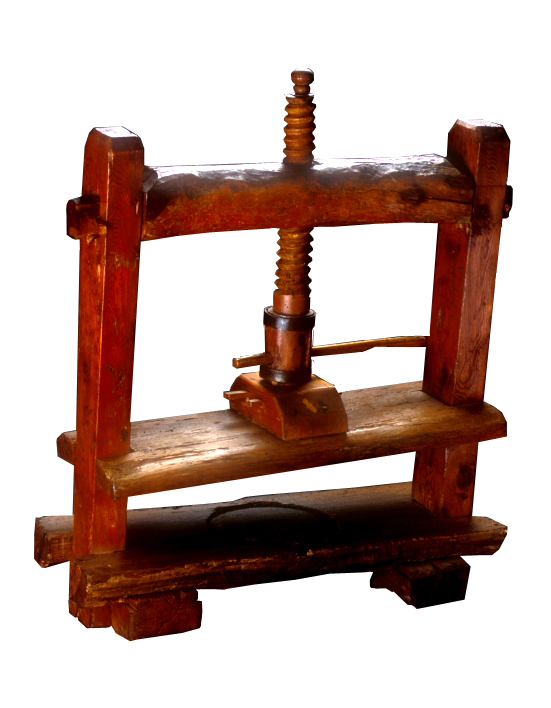
A single central circular wooden press, for processes that require gentle and continuous pressure, which belongs to the MARQ's Historical Collection and is currently on display in the Room dedicated to the Modern and Contemporary Ages in the museum's permanent exhibition (MO-VITRINA 14). The press is constructed from a frame of wood on four legs arranged in an inverted "V", by means of sawing, assembling and winterising techniques. The pressing mechanism is made up of the upper beam and the central circle that runs through it: operated by two springs, it presses the product (cheese) placed inside a circle on the lower beam or flat. The carved groove guides the product resulting from the pressing (serum) into a container that is placed under the press. The only metal elements are the iron collars that hold the handles to the circle. In the intervention carried out at MARQ in 2001, the cork was removed and the pots were sawn off because they were badly affected. The current state is stable and no new marks of the cork's action can be seen.
Wooden premses with a caragol cylinder were used in the traditional production of honey and wax, cheese, cider, cider, wine, olive oil and panfígol. The pre-milling mechanism is common to all these pre-industrial machines; however, in this case, the groove in the rim and the elongated crosshead for distributing and attenuating the pressure indicate that it is a pre-mill for making cheese. However, it is also common for the formatting presses to also be used to make panfigol, as it is common in the context of family production for different products to be made on the same machine.
In pre-industrial technology, the first documented prehistoric tools are those made of cotton, which appeared during the Hellenistic period (323-30 B.C.). The caragol prems were developed at almost the same time. This type of premses, with a caragol-shaped round and made entirely of wood, became widespread in the 19th century and lasted until the middle of the 20th century, when the mechanisation of food production replaced the handmade craftsmanship of the Castilians.
The production of cheese in the rural and family environment is a way of conserving the milk left over from the munching process. A ring or ring is used to shape the cheese. Traditionally, these circles have been made, depending on the region, of esparto, ceramic, wood or tree branches and, later, of wool. Through the forats or the spaces between the wickerwork, the serum is evacuated. In this moulding, the column would fit into the groove carved in the lower beam. In the manual production of the cheese, a wooden container is used to drain off the serum, from which the groove takes its shape.
Before the introduction of the press, once the manual pressing had been carried out for one hour, the formatted cheese had to be placed for 24 hours between two pressurised trays with large stones to complete the process. The use of this type of press reduces the effort and duration of the process of extracting the serum.
Although some wax beehives have the same morphology as those made of wax, they usually have an iron or wood handle with an inner symbol that concentrates and increases the force exerted on the bees, as greater pressure is needed to obtain the wax. It was also in the 19th century that some beekeepers introduced honey bees to separate the honey and the wax. Traditionally, this was done by hand. In the middle of the 20th century they were replaced by the more efficient honey centrifuge.
In the same way, in the elaboration of wine, this type of press is also used for a second processing of the raïm: once the two trepitjats are finished, the remains are passed through the press. The resulting product (known as 'premsa') is mixed with the wine obtained in the threshing process because it has other properties. The wooden press-press fusos preserved in the Museu del Vi (Vilafranca del Penedès) bear witness to the use of this type of press in the production of wine. Single-fusel premses are difficult to find nowadays, while double-fusel premses are still abundant in La Rioja.
PARAL-LELS
Premsa de formatge (INV No: 1989/058-001).
Provinent de Zamora, in "ENSERES", Ethnographic Museum of Castilla y LeónFundación Siglo para las Artes en Castilla y León, D.L., 2002. p. 265.
Taulell i lawsuit d'espart per fer formatge (INV NO: 1.782)
Provinent d'una casa familiar del Camp d'Elx, Museu Escolar de Pusol (Elx)
Vessel for collecting the serum
Sopeña Pérez, F.; "El queso de Aliva: una elaboración artesana" in Narria: Studies in popular arts and customsUniversidad Autónoma de Madrid, Museo de Artes y Tradiciones Populares, vol. 12, 1978, p. 18, Fig.5.
Panfígol press (INV NO: 15,524)
Provinent d'una casa familiar del Camp d'Elx, Museu Escolar de Pusol (Elx)
Premsa de cera (INV No: CE01335)
Ethnographic Museum of Cantabria, permanent collection.
Premsa de cera (INV No: 6717).
Provinent de San Martín de Humada (Burgos), in "Animalario, visiones humanas sobre mundos animales", Costume Museum. Ethnological Heritage Research CentreGeneral Technical Secretariat, Ministry of Culture, 2005, p.276.
Premsa de cera
Col-lecció Abert Simón, in Lemeunier, G.; "Geografía de la cera en España y Francia", Economic History Researchvol.7, 2011, p.6, fig.6.
Premsa de cera (INV NO: 00100)
Provinent de Ceresola, "Catálogo del Museo Ángel Orensanz y Artes del Serrablo", ed. DPH, 1980, p. 57.
Premsa de vi i sidra
Museu d'Ojacastro, in Alarcón Román, C.; Conde López, S. and Rodríguez Collado, M., "Artesanías Riojanas" in Spanish EthnographyMinistry of Culture, vol. 6, 1987, pp.192-193.
Premsa d'oli
Caserío de San Benito, Alameda (Málaga) in Gómez Delgado, B. M.; "Viga y quintal presses: pervivencia y evolución de tecnologías preindustriales en la producción agroalimentaria. El caso de la Hacienda Cerero en San Lúcar la Mayor", in Andalusian Conference on Industrial Heritage and Public Works, 2012, p. 7
BIBLIOGRAPHY
- Lafuente Vidal, J.: "Museo Arqueológico Provincial de Alicante. Catalogue-Guide", Institut d'Estudis AlacantinsXII, 1959, p. 78, INV no. 215.
COMPLEMENTARY BIBLIOGRAPHY FOR IDENTIFYING THE FUNCTION OF THE PRESS
About the artisanal production of formatge
- De Leidaola, F., "El pastoreo tradicional en Guipuzkoa" in Narria: Studies in popular arts and customsUniversidad Autónoma de Madrid, Museo de Artes y Tradiciones Populares, vol. 55-56, 1991, pp. 23 and 24.
- Fernández de Paz, E., "Artesanías y artesanos en la Sierra Norte Sevillana: aproximación etnográfica", inSpanish EthnographyMinistry of Culture, vol. 6, 1987, pp.166-169.
- González Mena, Mª A., "Tradiciones ganaderas en antigüedad. Un rincón del cerrato palentino" in Narria: Studies in popular arts and customsUniversidad Autónoma de Madrid, Museo de Artes y Tradiciones Populares, vol. 14, 1979, p.16-17.
- Sánchez, E.; Timón, Mª P. Y Salmador N.; "La cerámica relacionada con la Leche y sus derivados" inNarria: Studies in popular arts and customsUniversidad Autónoma de Madrid, Museo de Artes y Tradiciones Populares, vol. 8, 1977, pp. 3-4.
- Sopeña Pérez, F.; "El queso de Aliva: una elaboración artesana" in Narria: Studies in popular arts and customsUniversidad Autónoma de Madrid, Museo de Artes y Tradiciones Populares, vol. 12, 1978, pp. 17-19.
On the artisan production of honey and wax
- Díaz Maderuelo, R.; Zapata de la Vega, J.; Adánez Pavón, J. and Quinto Romero, Mª Luisa de, "El oficio artesano de la cerería en Segovia" in Spanish EthnographyMinistry of Culture, vol. 5, 1985, pp.273-351.
- Lemeunier, G.; "Geography of wax in Spain and France", Economic History Researchvol.7, 2011, p.6, fig.6.
- López Álvarez, J.; "¿Animal doméstico o animal salvaje? La relación del hombre y las abejas" in "Animalario, visiones humanes sobre mundos animales", Costume Museum. Ethnological Heritage Research CentreGeneral Technical Secretariat, Ministry of Culture, 2005, p.82.
- López Álvarez, X.; "Las Abejas, la miel y la cera en la sociedad tradicional asturiana".", Royal Institute of Asturian StudiesOviedo, Oviedo, 1994.
- Padilla Montoya, C., "Las colmenas sorianas. Miel y cera." in Narria: Studies in popular arts and customsUniversidad Autónoma de Madrid, Museo de Artes y Tradiciones Populares, 1978, vol. 11, pp. 15 and 16.
- Sánchez Trujillano, Mª T.; Gómez Martínez, J. R.; "A un panal de rica miel", Museum of La RiojaLogroño, 2001.
On the artisanal production of olive oil
- Gómez Delgado, B. M.; "Beam and quintal presses: survival and evolution of pre-industrial technologies in agri-food production. The case of the Hacienda Cerero in San Lúcar la Mayor", in Andalusian Conference on Industrial Heritage and Public Works, 2012
On the artisan production of wine
- Alarcón Román, C.; Conde López, S. and Rodríguez Collado, M., "Artesanías Riojanas" in Spanish EthnographyMinistry of Culture, vol. 6, 1987, pp.192-193.
- Chasco Oyon, J.A., "La elaboración artesanal del vino y del aceite en La Rioja Alavesa" in Narria: Studies in popular arts and customsUniversidad Autónoma de Madrid, Museo de Artes y Tradiciones Populares, vol. 53-54, 1991, p.37.
- Merino, A. "The Haystack-Museum de objetos e instrumentos Populares en Ojacastro" in Narria: Studies in popular arts and customsUniversidad Autónoma de Madrid, Museo de Artes y Tradiciones Populares, vol. 10, 1978, pp. 33-36.