
CATÀLEG

AIXADELLA
La Escuera (Sant Fulgencí)
Ferro
h: 30 cm; a: 11.4 cm; e: 13.8 cm
Ibèric
3rd century BC
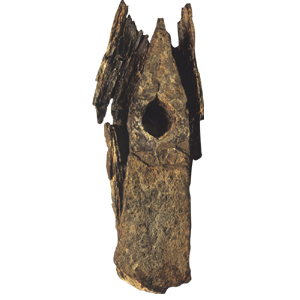
Double-sided barrel with two opposite ends, one vertical and the other horizontal. In the central part there is a circular perforation for inserting a wooden mallet. It is still very deformed due to exfoliation and separation of the iron plates that make up the instrument.
One of the signs of identity of the Iberian culture is its mastery of iron metallurgy. Iron was used to make tools that enabled new activities to be developed and others to be made more productive, especially in agriculture (aixades, falçs, podalls, etc.). One of the most singular is the large aixadella of La Escuera, a unique piece of land due to its size. As its resemblance to the fes, an instrument of traditional Valencian agriculture, suggests, it was used as a destral on one side and as an aixadella on the other. It was especially useful for digging hard ground and for pulling up trees, as its great weight makes it easy to dig around the trunks; the roots and trunk are carved with the side of the skeleton. Similar smaller fish, or picoles (an example is on display in the Iberian room), were used for carving stone, in the trowel trade and in ironwork.
CS: 2765
NORDSTRÖM, S., 1967.