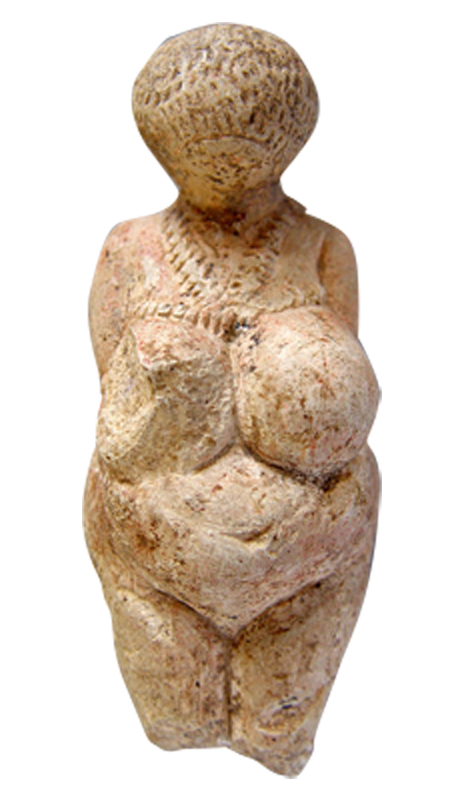

VENUS OF KOSTENKI
Female statuette
Culture Kostenki-Avdeevo
Kostenki I (Poliakova), upper level, second
housing complex. Eastern Europe, Don River.
Excavations by N. Praslov, 1983.
Upper Palaeolithic, 23-21 thousand years ago.
Limestone.
10.3 cm x 3.5 cm. NO. 2928/12.
The sculptural representation of a nude woman with exaggeratedly shaped breasts and belly is executed according to the compositional scheme of the Gravettian period. The accentuated female forms, the absence of features on the face, the inclination of the head, the slender arms close to the torso and the close-fitting legs with well-defined hip lines are complemented by the flatness of the back and the detailed modelling of ornaments in relief.
The statuette's ornamentation gives it a unique character. The neck cap resembles a braided base to the front of which strings of beads were attached or leather braids were sewn with appliqués, as evidenced by the existence of linear rows of notches.
The shape of the chest bandolier with straps over the shoulders, as well as the bracelets above the elbow and on the wrists, are made using a cutting technique. In reality, the ornaments could be made from organic materials such as leather, fur and plant fibres. The surface of the statuette was well smoothed and painted with red ochre. On the buttocks and hips, groups of scratched lines can be seen, confirming the process of surface treatment or partial representation of clothing (braids of threads, ropes and leather ribbons). The statuette was broken in antiquity, as after its use in a ritual or the loss of its significance, clay statuettes were beaten off their heads and legs. The chest and belly were damaged with small vertical blows.
The figurine was found face down on the floor of a half-buried cave. The semantics of the female image in Gravettian art (23-22 millennia BC) remains a mystery to this day. The first finds of the figurines in the 1920s-1930s allowed us to speak of matriarchy, later they were interpreted as Mother Goddesses, as mistresses of the household or of the animal world and were declared symbols of fertility and procreation.
S.A. Demeschenko