

Piece of the month
Altar of Temple B of the Illeta del Banyets in Campello
It is a small altar carved in a block of sandstone, which was found in 1983, during the course of Enrique Llobregat's 12th excavation campaign at the Illeta dels Banyets archaeological site. Its dimensions are small: 12.3 cm on each side and 16.5 cm high. The upper part is divided into three main bodies made up of a kind of abacus with a square, sunken surface measuring 8 cm on each side on the upper face, which may have been used to burn essences and perfumes, without ruling out the possibility that it could have been used to hold small libations. This body rests on an inverted truncated pyramid-shaped surface that connects to a mouthpiece. Finally, another smooth body of smaller dimensions than the upper one was carved, and from here, the base of the base. Photographs of the excavation process show two right-angled incisions that could be the beginning of a cartouche, but these are not currently preserved on the piece.
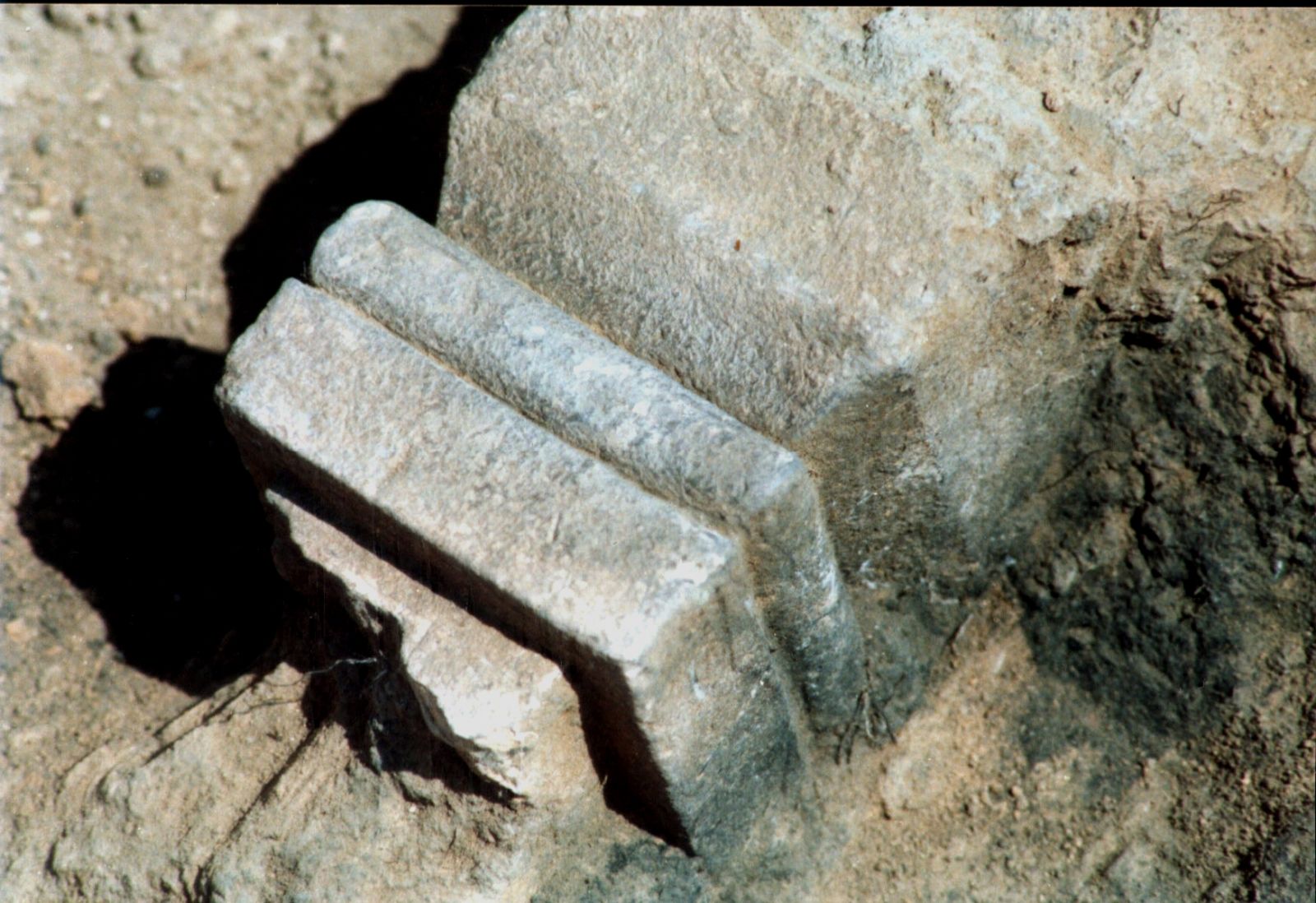
At the time of its discovery it was already fragmented, so that only the upper part was preserved. In the lower part there were remains of wood that possibly belonged to a small piece of furniture that served as a base. This leads us to believe that the altar was being reused after it had been broken, which undoubtedly indicates the degree of reverence and respect that the inhabitants of the Illeta must have had for this element of worship. Thanks to the data transmitted by E. Llobregat in his excavation diaries, it has been possible to reconstruct the position of the altar inside the temple, reaching the conclusion that it was located in the centre of the stone slab between the two columns, and at a height of no more than 0.90m. A replica of the altar has been placed in its position on a metal support at the site, as the lack of data prevents us from hypothesising about the type of furniture that would have supported it in antiquity.
This type of piece is found with some frequency in Phoenician and especially Punic contexts, with important finds in the western Mediterranean, especially in Carthage, in Sardinia at the sites of Mozia and Sulcis, and in Sicily. Some specimens have also been found on the Iberian Peninsula, although their number has so far been less significant. The ones that most resemble our specimen are two pieces from the necropolis of Los Villares, Almería, and one from the Tarsis de Riotinto mines (Martín, 2009, 47; Belen, 1994, 264-265). They are truncated pyramid-shaped pieces with a moulding and ridge on the front face and the two sides and a smooth, vertical back. The upper part has a shallow rectangular concavity. They were plastered with white plaster. They belong to Tore's type D/1 or D/1a. All of them have been found in ancient excavations or out of archaeological context, which is why they are attributed a very broad chronology, ranging from the 8th century BC to the 4th century BC, although the examples from Los Villares are dated between the 5th and 4th centuries BC, which is more in line with the site of La Illeta.
.jpg)
Normally these altars with perfume burners are related to funerary contexts, associated with necropolises, tombs or sarcophagi, but in our case the altar was inside Temple B, at the level of the upper pavement, next to one of the columns, and very close to the stone slab. Some researchers, such as Llobregat, think that the temple was dedicated to a goddess of fertility and death, while others, such as Almagro and Moneo, attribute a gentilic character to this temple, considering that it would have been used to worship a sacralised ancestor. The presence of an altar of this type inside the temple seems to ratify both interpretations, since in the first case it would be directly linked to the funerary world, while in the second case the cult of ancestors, as well as strengthening the family bond and identity, forms part of the rites with which homage is paid to the deceased personage who is the founder of a lineage.
Although we cannot specify the type of rites that were carried out in temple B, the importance of the altar lies in the fact that it is one of the many elements that help us to try to understand who the inhabitants of the Illeta were. The religious and funerary context is deeply rooted in the collective subconscious of the people. The traditions and rituals with which a collective tries to deal with the dangers that arise in the course of everyday life are not easy to change. This is not the time to go into this subject in depth, but in this case we are dealing with a Punic altar that was used to perform rituals of the Punic cult, located in a temple whose architecture is very similar to that of other Punic temples. We are therefore looking at a population that knows and takes on Punic rites as their own. But this altar is not the only piece of information from the site that suggests that the inhabitants of Illeta dels Banyets belonged to this culture; its geographical location, the use of Punic construction materials, the use of techniques for processing foodstuffs that were not very common among the Iberians, the abundance of imported movable materials all point to a Punic presence at Illeta dels Banyets.
A. Martínez Carmona
Bibliography:
Almagro-Gorbea, M.; Moneo, T. (2000)
Urban Sanctuaries in the Iberian World. Bibliotheca Archaelogica Hispana 4. Royal Academy of History. Madrid
Belen, María (1994):
Religious aspects of the Phoenician-Punic colonisation of the Iberian Peninsula. The stelae of Villaricos (Almería). SPAL Journal of prehistory and archaeology of the University of Seville, no. 3, p. 257-280.
Benichou-Safar, H. (1982):
Les tombes peniques de Carthage. Paris.
Llobregat Conesa, E.:
(1984) An oriental type perfume altar at the Iberian site of Illeta dels Banyets (El Campello, Alicante). Bulletin of the Spanish Association of Orientalists, XX, 301-308.
(1985) Two Iberian temples inside the village of Illeta dels Banyets. Fonaments,5, p. 103-112.
Martín Ruiz, J. A. (2009):
Phoenician funerary stelae in Andalusia. Herakleion, 2, pp. 41-55.
Moscati, S. (1987):
The offices of Tharros. II University of Rome. Dipartamento di Storia. Studia punica 2. Roma.
Olcina Doménech, M.; Martínez Carmona, A.; Sala Sellés, F. (2009):
La Illetadels Banyets (El Campello, Alicante). Iberian and Roman periods I. History of research and synthesis of recent interventions (2000-2003). Alicante: MARQ, Museo Arqueológico Provincial de Alicante. Serie Mayor, num. 7
Tore, G. (1998):
Cippi, altarini, stele e arredi. Palermo punica. Museo archeologico regionale Antonino Salinas. 6 December 1995- 30 September 1996. Selerino editore Palermo. P. 417-427