
PART OF THE MONTH
LID COVER OF LEKÁNE RED-FIGURE ATTICA
TM'91-2861
CS. 16721
Ceramics
Rim diameter: 26 cm (approx.)
Maximum length: 8.9 cm
Maximum width: 7.3 cm
Early-Pliocene Iberian Period
Late 5th and early 4th century BC.
During the excavations carried out in the Tossal de Manises in October 1991, two ceramic fragments were discovered, probably corresponding to the same piece based on the analysis of their morphological and decorative characteristics. They are a lid from lekáneThe shape is of Greek origin and covered a kind of shallow dish or bowl with two horizontal handles. It can be classified as a Sparkes-Talcott type 1226-1241.
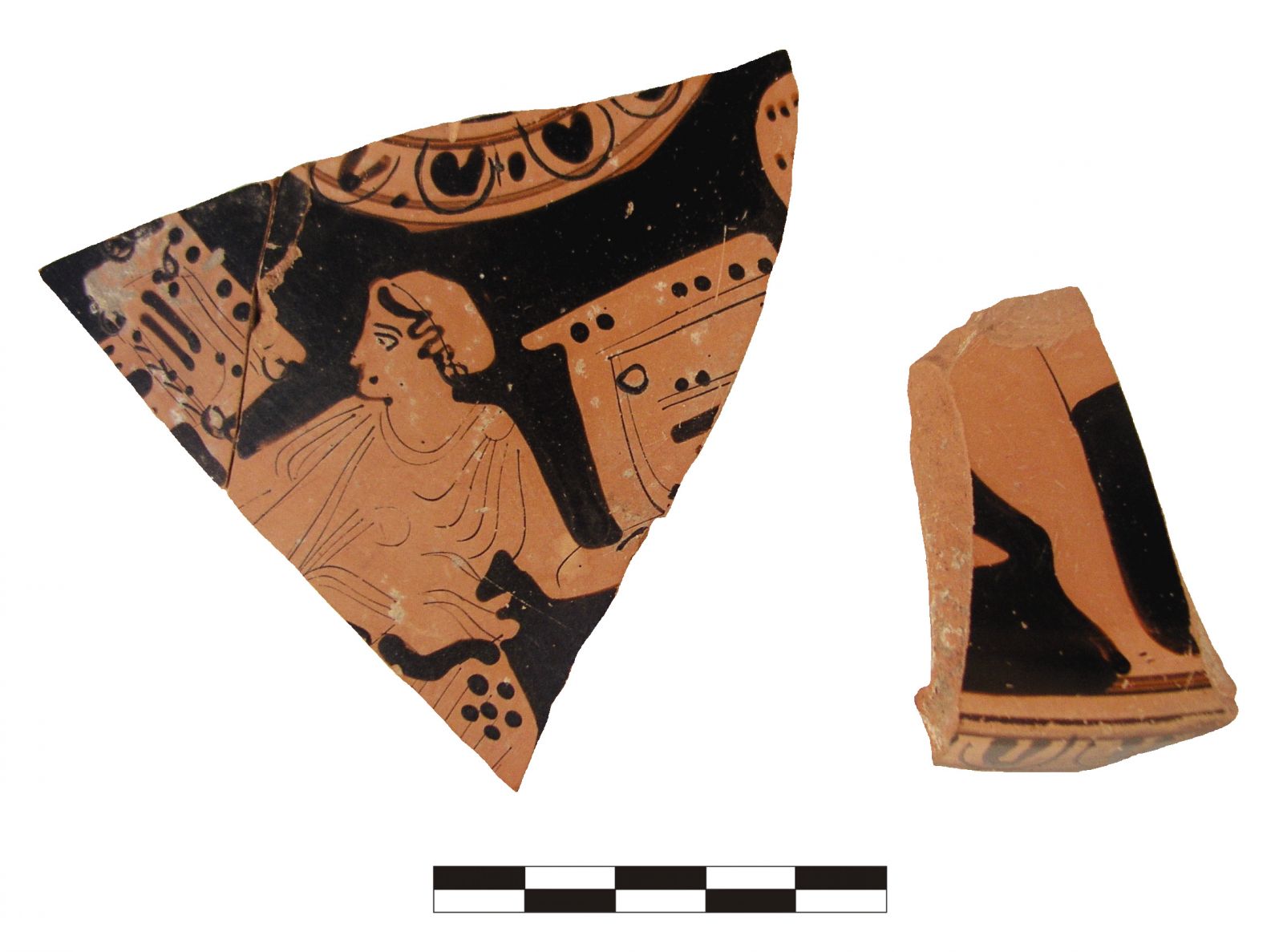
Fragments of the cover of lekáne Attic of red figures from the Tossal de Manises.
One of the fragments belongs to the rim area, which takes the form of a smooth vertical band with a rounded lip. The second corresponds to the body of the lid, and near a fracture the start of the central knob by which it would have been held seems to be visible. The paste in both cases is fine, very refined and orange in colour, and they are covered with a dense glossy black varnish, with some spaces remaining on the outside, following the style known as red-figure.
The rim has the typical horizontal band in the form of an ovate border and on the body there is a bare leg, presumably human. In the larger fragment, a wreath of alternating dots and ovals and a small part of a scene can be seen around the start of the knob. In the centre is a female figure looking to the left, with her hair tied back and her head covered with a scarf or sakkósdressed in a chiton Ionic, a garment of very fine fabric with wide, moving folds, fastened over the left shoulder and held in place with a belt. This figure holds his forearms outstretched, holding a kind of box or tripod in his right hand and another quadrangular element, probably a piece of furniture, in his left.
The lekáne The vessel is a wide, shallow vessel with two horizontal, symmetrical handles and a lacy rim for its lid. The lid would have had a knob or circular handle in the centre and was usually decorated with scenes of the gynoecium, i.e. the female world. In fact, this type of vessel was used by women of a certain economic power and social standing when they were grooming themselves, as part of their personal trousseau.
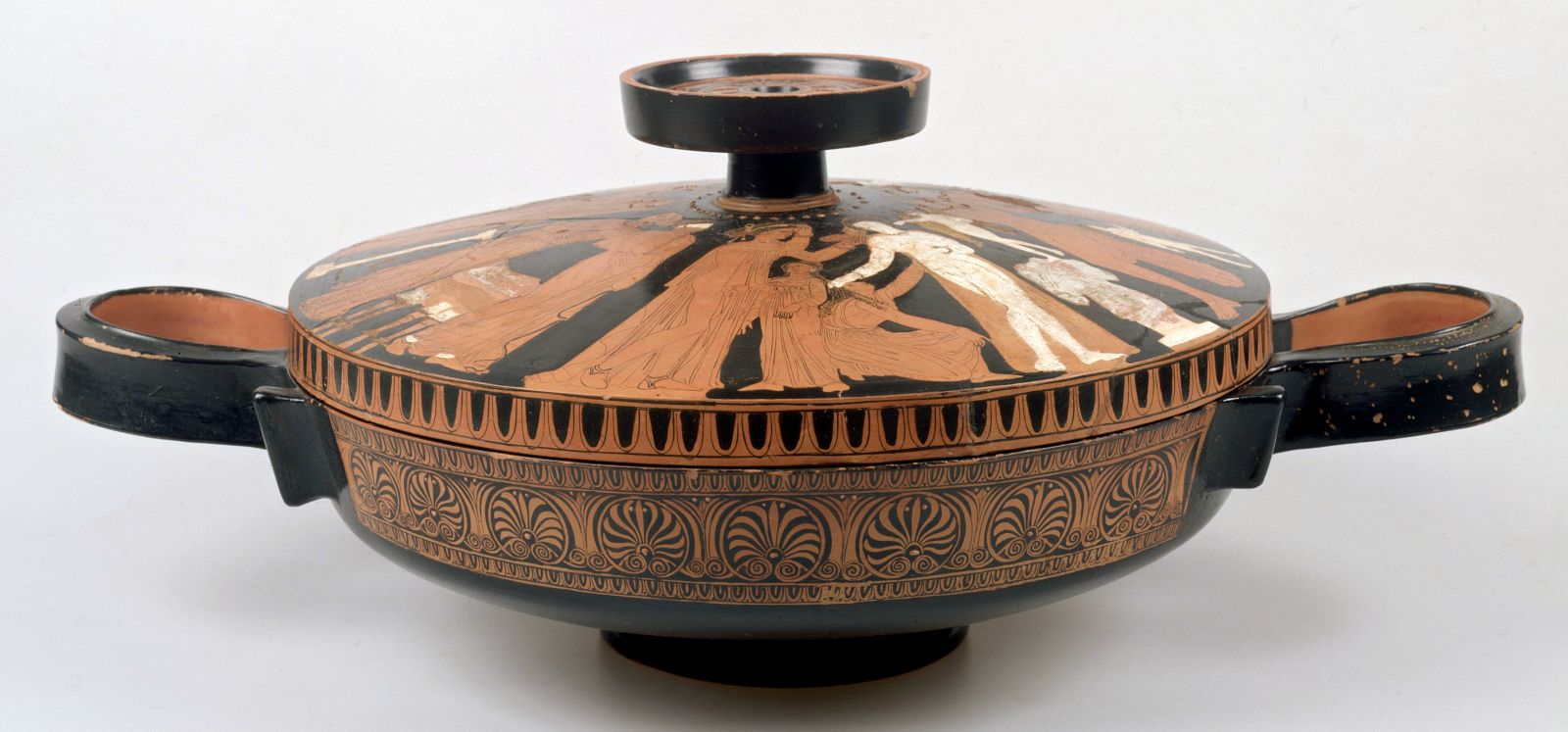
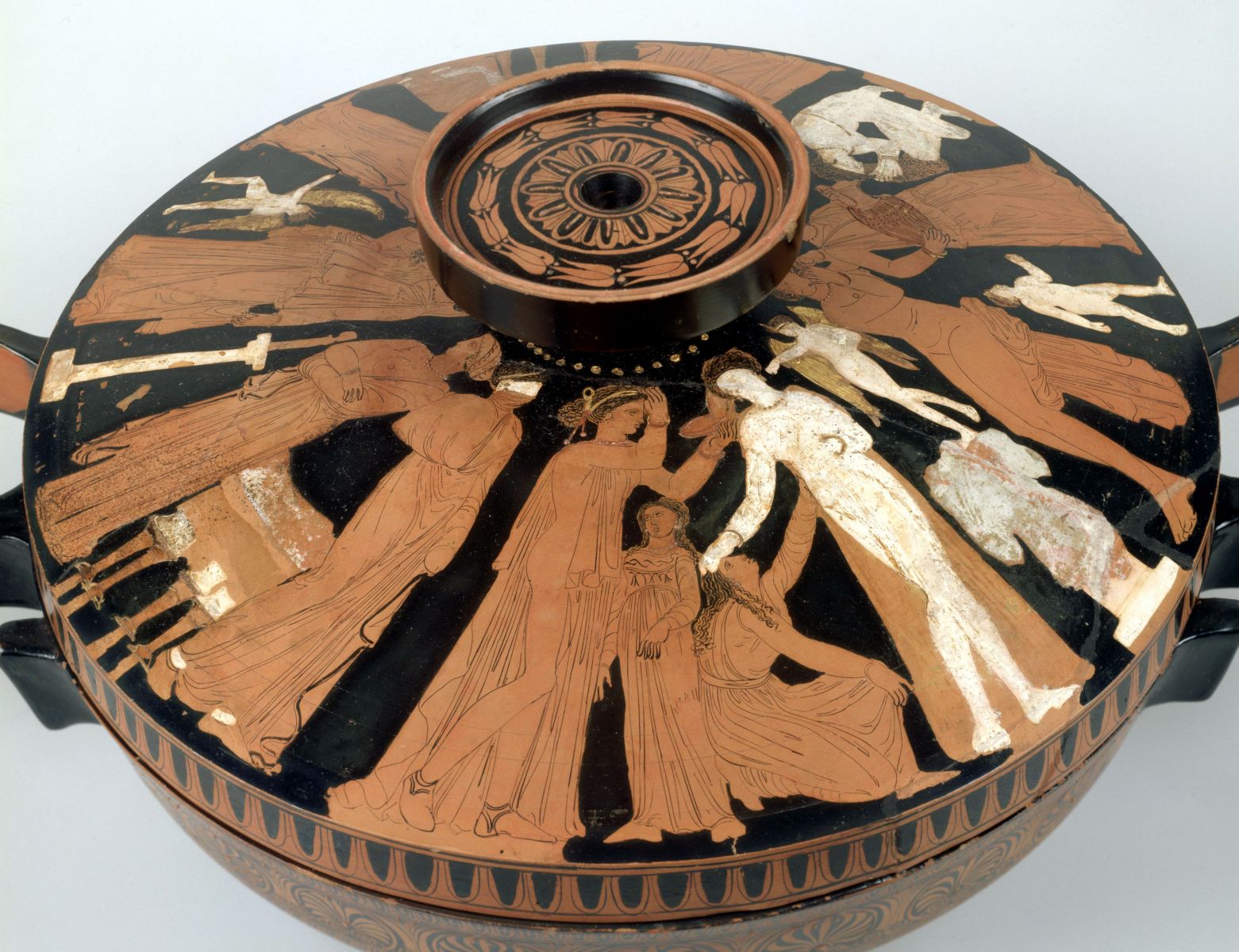
Lekáne from the State Hermitage Museum (St. Petersburg, Russia). Exhibited in 2011 at the Museo Arqueológico de Alicante as part of the exhibition Hermitage. Treasures of Russian Archaeology at MARQ.
Many of the red-figure ceramic forms reflect scenes of festivities, banquets, religious celebrations, etc., and from the second half of the 5th century BC onwards there are images of women in different poses: seated, chatting, spinning or weaving, carrying various objects related to the female world such as boxes, perfume burners, wreaths of flowers, baskets, etc. These scenes, interpreted as the bride's preparations before the wedding or the visit of the bride's friends after the event, are also found on the covers of lekánaiThey also decorate vessels as diverse as ointments and essences. (lékythoi), glasses (kýlikes,skýphoi) and liquid containers such as craters and hydras.
The decorative style of the piece and the subject matter seem to fit in with the creations of what is known as the Otchet Group workshop, which operated mainly between the end of the 5th century and the beginning of the following century. Characteristic are the scenes of women wearing chiton, sometimes with a cloak or himation overlapping, with the hair normally held back by a ribbon or a sakkós. The noblewomen are shown seated next to Eros, who is always naked and winged, while the maids, as in this case, run around carrying various items, mainly cloths, small boxes and wedding vessels.
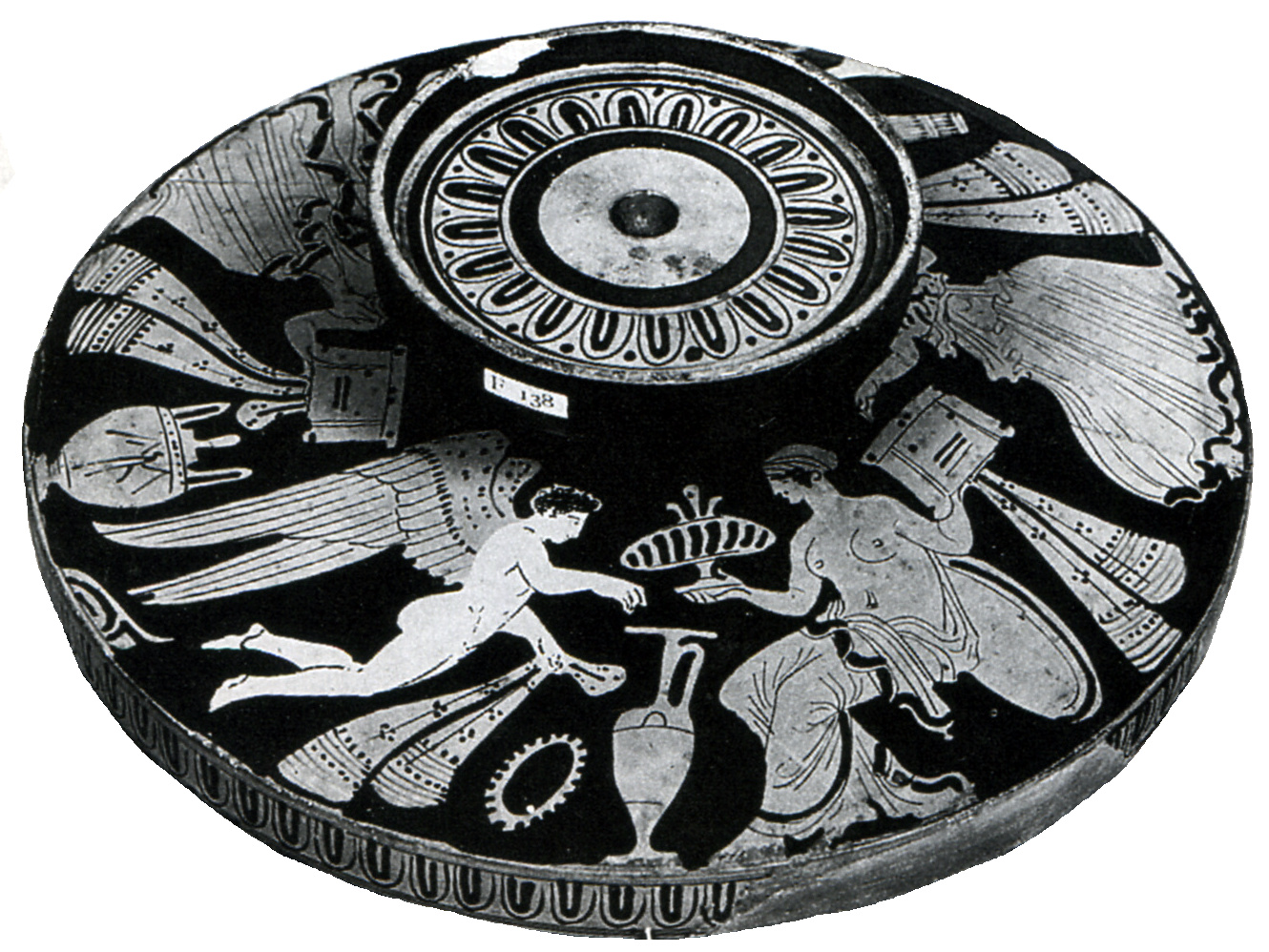
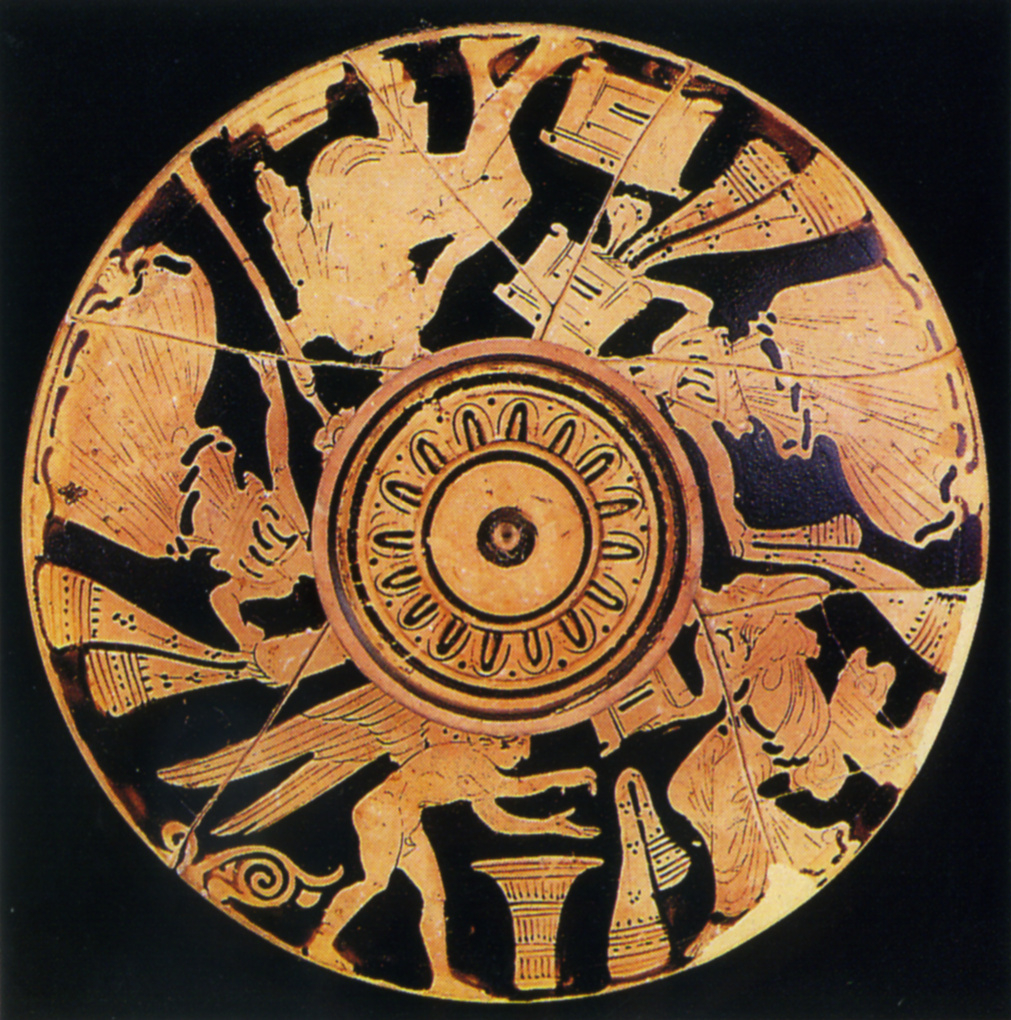
Covers from the workshop of the Otchet Group in the British Museum (left) and the Museo Nazionale di Firenze (right).
This object was originally a common gift for brides, becoming very popular from the end of the 5th century BC onwards, and was mass-produced and marketed throughout the Mediterranean until it reached the Iberian Peninsula. In the Iberian world the lekánai may have been used to contain spices, threads, toys, and the lids in particular would have served as plates, and some examples have been found in necropolis, where they have been interpreted as funerary offerings. Such would be the case of the known pieces from the necropolis of Cabezo Lucero (Guardamar del Segura), l'Albufereta (Alicante) and Coimbra del Barranco Ancho (Jumilla, Murcia), the former also the work of the same workshop as the Otchet Group, although with a more degenerated style, typical of the mid-4th century BC, and the latter two with a different theme (scenes with wolves, lions and griffins).
There are also several known specimens of lekánai at Emporion (l'Escala, Girona), dating from the second half of the 5th century and mainly from the 4th century BC. Two tapestries from the Otchet Group, from the last quarter of the 5th century BC, and another in the style of the Painter of Dinos, also with a nuptial theme, dated to the third quarter of the same century, stand out in this place. Other fragments have been documented in Ullastret (Girona), dated to the second quarter of the 4th century BC, and in Mas Castellar (Pontós, Girona), dated to the first half of the 4th century BC. Outside Spain, there are parallels in the British Museum, the Museo Archeologico Nazionale di Firenze and the State Hermitage Museum in St Petersburg.
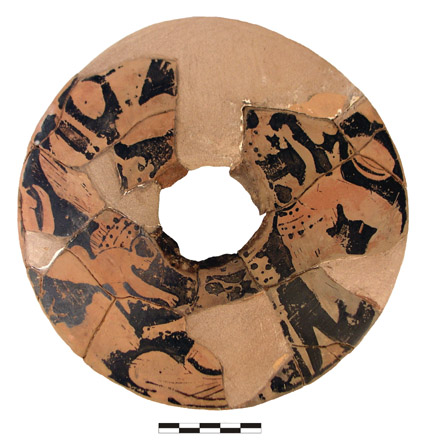
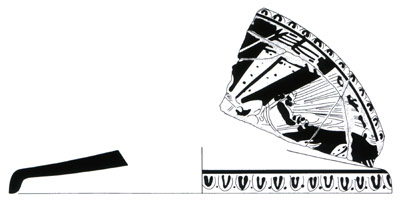
Lids from the Otchet Group workshop at the necropolis of Cabezo Lucero (left) and Mas Castellar (right).
This cover of lekáne is added to the group of Attic ceramics from the Tossal de Manises, from which it has been considered that the habitat in this place would have begun at the end of the 5th century or beginning of the 4th century BC. However, all these materials have always appeared in secondary contexts, basically fill strata from the second half of the 3rd century BC, made up of earth from a previously occupied area on the same hill or in the surrounding land. The existence of a primitive Iberian site is currently defended, although we do not know any of its structures, as they were razed to the ground by later constructions.
Enric Verdú Parra
Cabinet of Collections and Researchers-MARQ
BIBLIOGRAPHY:
ADROHER, A. M.; FERNÁNDEZ HIDALGO, M. J.; GARCIA MARTIN, J. M.; LÓPEZ MARCOS, A.; PONS BRUN, E. (2002): "L'estudi ceràmic". In PONS BRUN, E.: Mas Castellar de Pontós (Alt Empordà). An archaeological complex from the Iberian period. (excavations 1990-1998). Archaeological Museum of Catalonia - Girona. Sèrie Monogràfica, 21, Girona, p. 232, fig. 10.7, no. 11.
ARANEGUI GASCÓ, C. et alii (1993): The Iberian Necropolis of Cabezo Lucero (Guardamar del Segura, Alicante), Casa de Velázquez Collection, 41, Heritage Collection, 17, Madrid-Alicante, p. 190, fig. 34, no. 14, plate 71.
BEAZLEY, J. D. (1962): Attic Red-figure Vase-paintersLondon.
BOARDMAN, J. (1989): Athenian red figure vases. The Classical PeriodLondon, London, p. 193, lams. 397-398.
ESPOSITO, A. M.; DE TOMMASO G. (1993): Vases attici. Museo Archeologico Nazionale di Firenze (National Archaeological Museum of Florence). AntiquariumFlorence, p. 83, plate 138.
GARCÍA CANO, J. M.; GIL GONZÁLEZ, F. (2009): Attic red-figure ceramics: workshops and trade (4th century BC.). The case of Coimbra del Barranco Ancho (Jumilla, Murcia), Murcia, pp. 62-63 and 97, fig. 6.
GARCIA I MARTÍN, J. M. (1996): "Les ceràmiques àtiques del Tossal de Manises (Alacant, L'Alacantí). Els fons antics del Museu Arqueològic Provincial d'Alacant", XXIII National Congress of Archaeology (Elche, 1995), I, pp. 467-472.
MALUQUER DE MOTES NICOLAU, J.; PICAZO GURINA, M.; MARTÍN ORTEGA, A. (1984): Corpus vasorum antiquorum. Musée Monographique d'UllastretI, Barcelona, pp. 37-38. I, Barcelona, pp. 37-38.
MIRÓ I ALAIX, M. T. (2006): Attic red-figure pottery from the Greek city of EmporionMonografies Emporitanes, 14, Barcelona, pp. 106, 199 and 208, figs. 504, 534 and 535.
OLCINA DOMÉNECH, M.; PÉREZ JIMÉNEZ, R. (1998): The Ibero-Roman city of Lucentum (El Tossal de Manises, Alicante). Introduction to the investigation of the archaeological site and its recovery as a public space.Archaeological Museum of Alicante, Alicante.
OLCINA DOMÉNECH, M. (ed.) (2009): Lucentum (Tossal de Manises, Alicante). Archaeology and HistoryMuseo Arqueológico de Alicante, Alicante, pp. 38-39.
PICAZO GURINA, M. (1977): The Attic pottery of UllastretBarcelona.
ROBERTSON, M. (1992): The art of vase-painting in classical AthensCambridge.
VV.AA. (1992): Cabezo Lucero. Iberian necropolis. Guardamar del Segura (Alicante), Alicante, p. 40, no. 54.