
PIECE OF THE MONTH. Funerary stele

Front B
Front A
|
FUNERARY STELE Origin unknown Limestone CS: 7208 Listing: Rosario Montero Romero (24/09/2014)
|
 S. XI (1 October 1047) // Thursday, 7 Rabbi'II of 439 Hegira
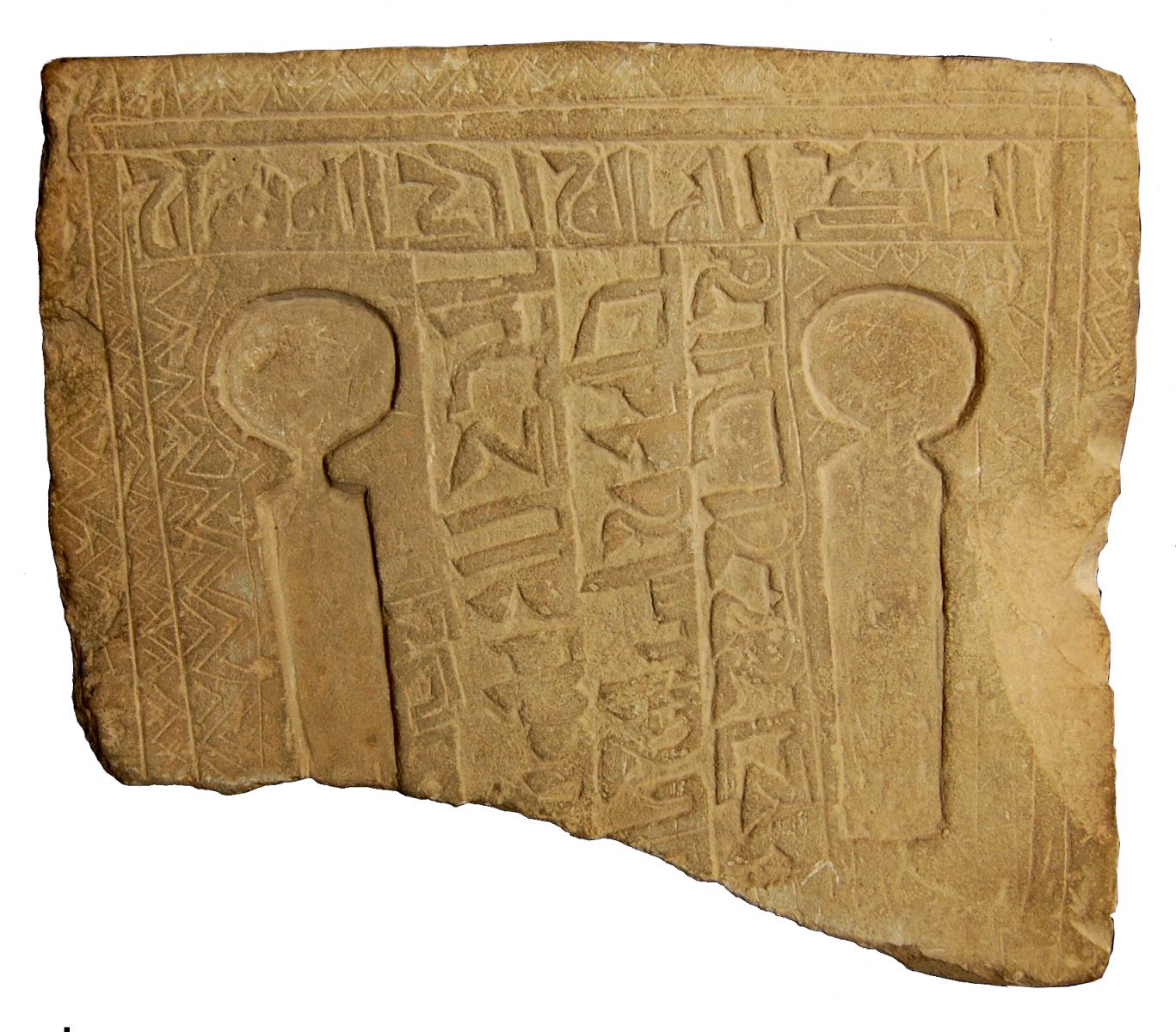
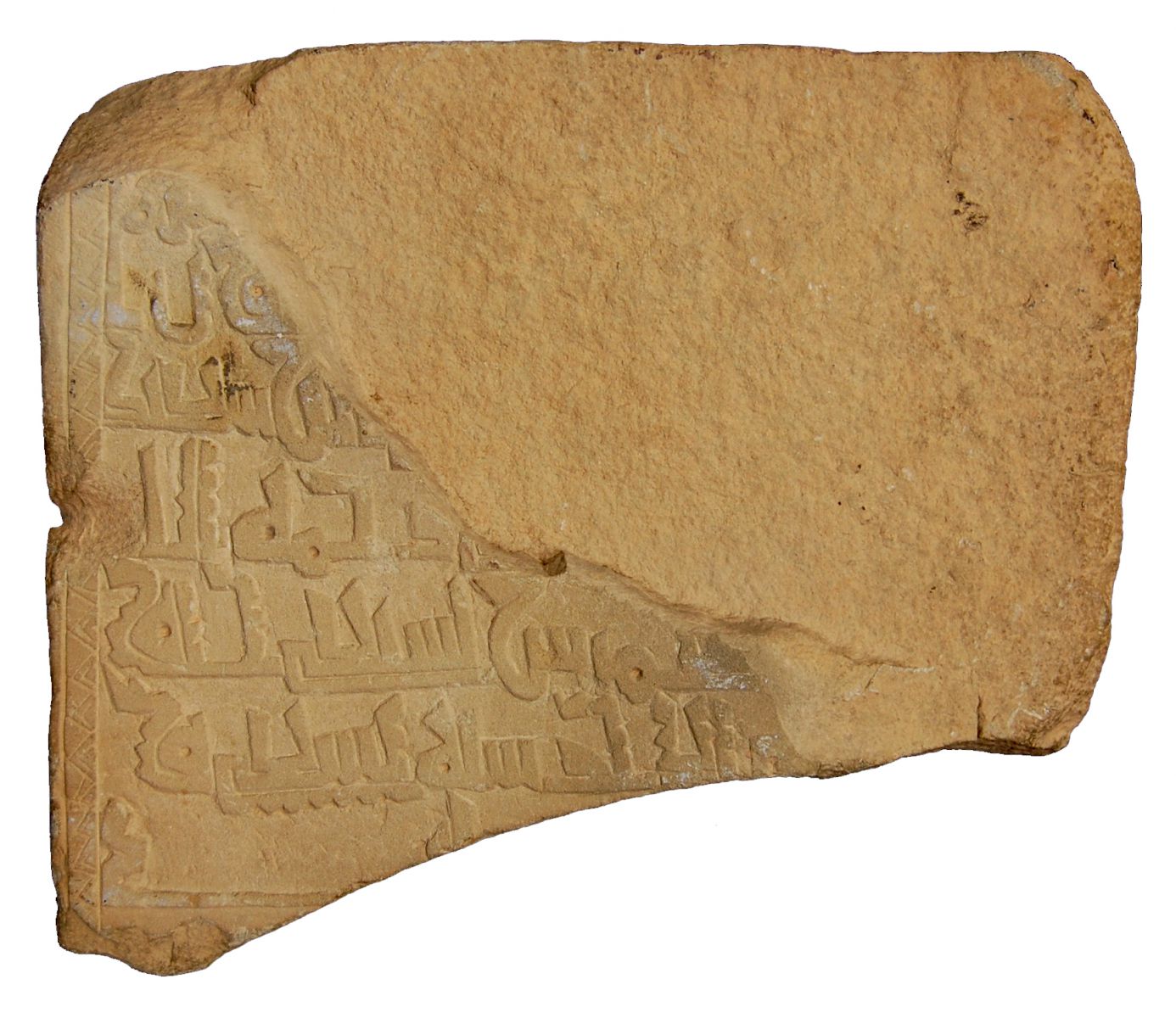
Rectangular, whitish limestone tombstone of a sepulchral opisthografic nature, with kufic writing in relief on both sides, using carving, chiselling and polishing in its manufacture. It forms part of the permanent exhibition at MARQ, and is on display in the Middle Ages Room-VITRINA-11.
It is a funerary stele, of a sepulchral nature and in good condition, except for its front A, where half of the inscription on the right side has been lost, which is now bare, and where a fracture in the lower part has caused the last line to disappear almost completely, as well as the framing. Even so, it is known that this front was composed of seven horizontal lines of epigraphic inscription.
Front B, on the other hand, has two gates imitating Islamic lobed-arch windows, also surrounded by a late kufic inscription in relief. Front B has two blind arches on either side, between which there are three vertical lines of inscription and a horizontal line of late kufic script at the top of the arches.
The funerary slab has a zigzag decoration, which also affects the moulding of the frame, consisting of double lines forming a ribbon and bordering the inscription itself.
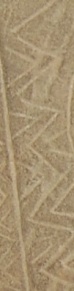
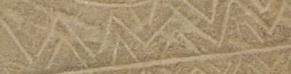


The lettering is kufic in relief, finished with almost floral finials and a curious way of decorating the horizontal and vertical strokes with a series of serrated points.

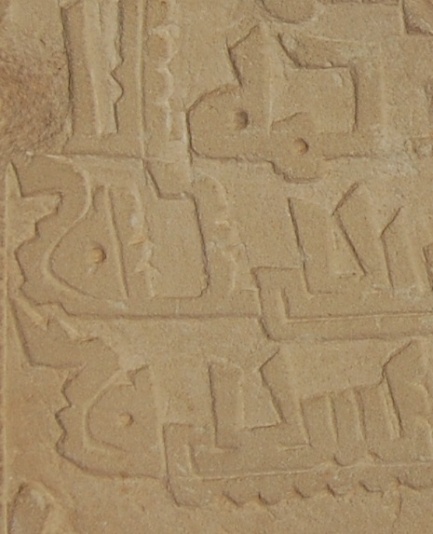

The transcription and translation of the front A is as follows:


1] In the name of God, the Gracious, the Merciful. 2] There is no divinity but God. Muhammad is the envoy of God.- 3] ios. This is the tomb of ('Ali or 'Isà or Yahyà). (?) [1]bn Sa'id 4] bn... He passed away -God be praised. 5] Thursday's diurnal, seven days after the- 6] the last rabbis of the ninth year and 7] thirty-four hundred. (BARCELÓ, T. I, 150-152)
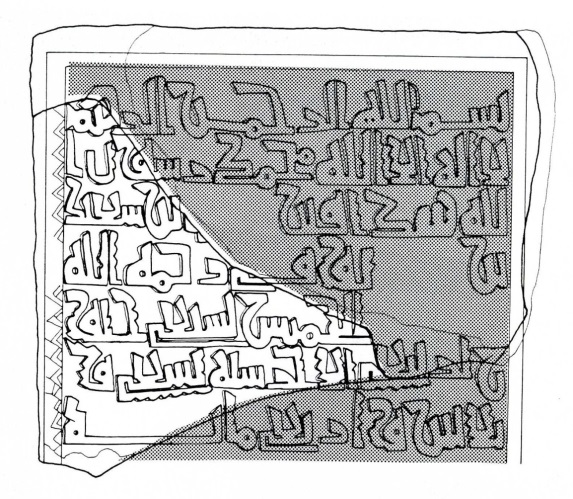
(BARCELÓ, T. II, Nº16)
The transcription and translation of the horizontal strip of the front B reads as follows:
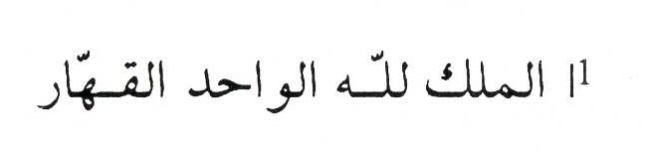

1] The dominion "belongs to God, the One, the Unconquered"(paraphrase of the Koran XL, 16) (BARCELÓ, T. I, 150-152).
[1] As in so many other Valencian inscriptions, only part of the name of the deceased has been preserved, which in no way facilitates his identification or allows us to know his personality or historical importance. "Before the 'bn' in line 3 there is a stroke which I think can be interpreted as a 'ya'. I have substituted in the translation - hypothetically - 'Isà, Yahyà or 'Ali, since all three readings are possible, but these adventurous substitutions do not resolve anything about the identity of the deceased". (BARCELÓ 1998, 152)
Finally, the transcription and translation of the vertical lines in the front B:


1] Praise be to God, who decreed the forfeiture (?) 2] of his creatures and reserved perpetuity for himself. (?) 3] and eternity He alone (?) (BARCELÓ, T. I, 150-152)
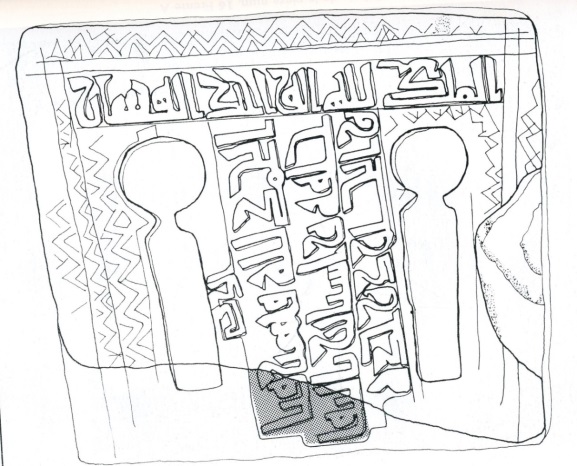
(BARCELÓ, T. II, Nº16)
Kūfī or Kufic is named after the city of Kufa, where it developed from the 8th century onwards. It is the oldest style: it was formerly called hiri, after the city of al-Ḥīra, capital of the Lajmid kingdom, and was originally influenced by the Syriac alphabet. It is characterised by pronounced angles and an overall square appearance. In order not to break its solid appearance, the dots of the letters are often reduced to small, almost imperceptible dashes. It is still one of the most widely used styles in signs and decoration today, and the one with the most variants, apart from having given rise to the Maghrebi and Andalusian styles. Its variants include:
* the flowery kuficin which the lines take on certain vegetal features and intertwine.
* the geometric kuficin which the letters are stylised and simplified to form geometric figures. It is one of the most commonly used styles in decoration, especially in mosaic and tile work, to which it is perfectly suited as it can be reduced to an addition of squares. Geometric kufic inscriptions are common on the exterior walls of mosques, minarets or the base of domes.
The place and date of the find are unknown, but it seems that it may have been made before the 1960s. Given the importance of Islamic Denia at this time, and the formal features of the writing, which allow us to relate this tombstone to the Marina Alta area, we cannot rule out the possibility that the funerary stele came from there. The same data would point to its probable manufacture in Denia (Alicante), as the lines of the letters allow us to relate it to the Marina Alta area, where similar inscriptions from Denia, Penáguila, Biar, Agres, Polop, Benirrama and Oliva, dating from the 11th century, have been preserved.
A cursory study would date the inscription to the hegira 500s, i.e. the 12th century. In addition, there are slight parallels in the design of the 'aynThe letter 'ha' in the form of a square open at the top is found in an inscription from Badajoz dated 556/1161 (LÉVI-PROVENÇAL 1931: no. 47, plate XII) as well as the letter 'ha' in the form of a loop and the '...' (LÉVI-PROVENÇAL 1931: no. 47, plate XII).haWith a large head on 12th-century Almerian tombstones (OCAÑA 1964: passim), although they do not have an identical layout to those on this funerary stele.
But in the 6th century of the Hegira it was only Thursday the 7th of the last rabi of the year 569, a very late date for the supposed epigraphic similarities and the only possible one since the slab preserves the word that marks the unit. On the other hand, the data provided by the tombstone and the comparison of its traces with others of very similar workmanship from the territory of the taifa of Denia, make it necessary to date the inscription to the middle of the 11th century.
The exact year can be restored with the theoretical dating tables, since in that century the 7th of Rabi' II or the last was only on Thursday in the year 439/1047. This data is also consistent with the design of the 'haThe sample made by Ocaña for the tombstones of Almería, where the one from the year 435 coincides exactly with the one shown on the funerary stele from Alicante (OCAÑA 1988: fig. 3).
BIBLIOGRAPHY
- AZUAR, R., Tombstone in limestone [EAT L, 1988, 62.
- BARCELÓ, C., Arabic writing in the Valencian Country. Monumental Inscriptions. T.I, Valencia, 1998, 150-152.
- BARCELÓ, C., Arabic writing in the Valencian Country. Monumental Inscriptions. T.II, Valencia, 1998, Fig. nº16.
- GISBERT, J. A., Maqbares de Daniya. The urban cemeteries of the Andalusian madina. WATERITS 21, 35.
- LLOBREGAT, E., Provincial Archaeological Museum of Alicante. Our museums. T.I, Valencia, 1989, 134.
- VV.AA., The Caliphate Rabita of the Guardamar Dunes. Ceramics, epigraphy, fauna, malacofauna. Diputación de Alicante, 1989, 175-195.