

Token of the month. Double-spring fibula

| DOUBLE-SPRING JAW Peña Negra (Crevillente) Bronze CS: 5213 Cataloguing: Pablo Camacho Rodríguez (2014) |
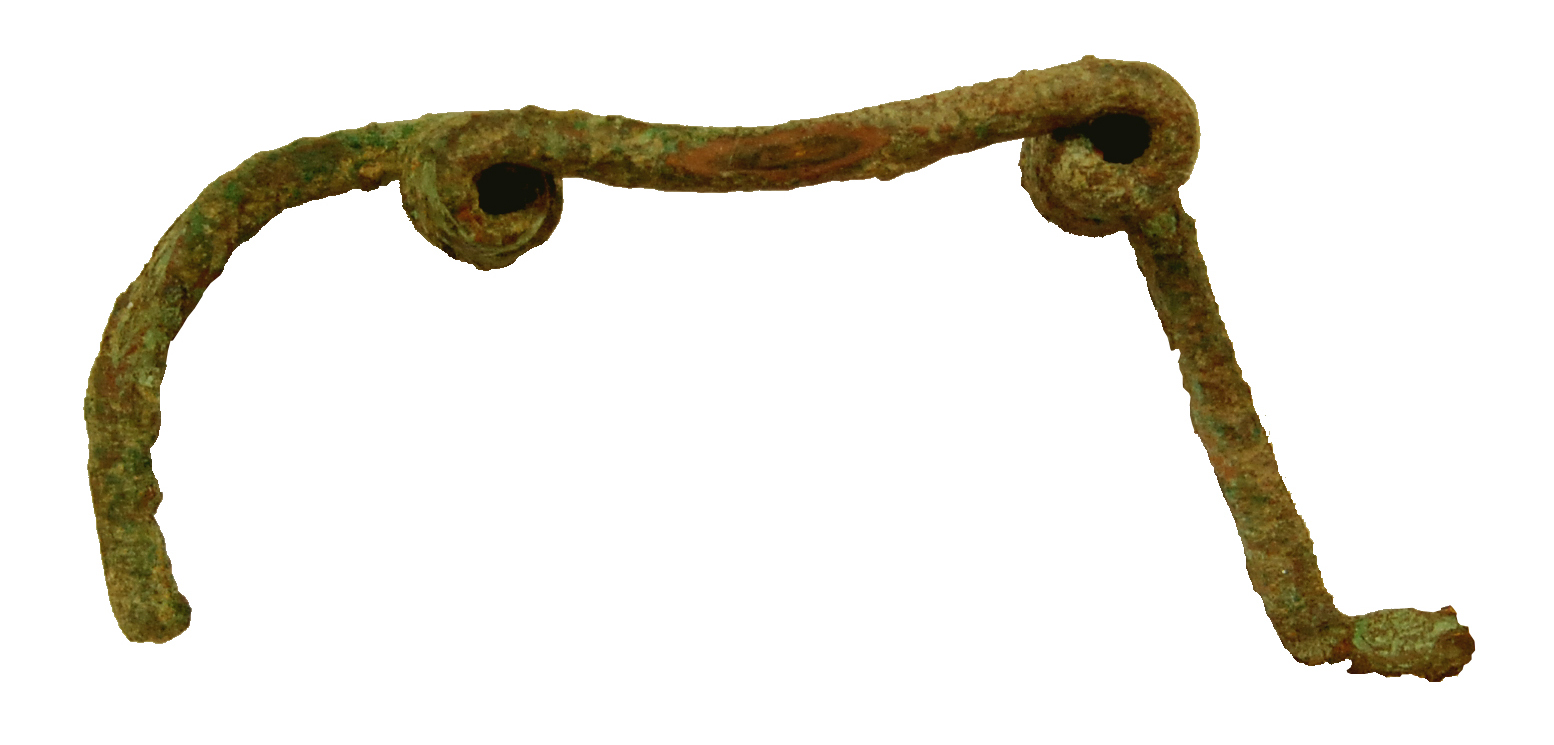
The fibula we are studying here comes from Sector VII of the Peña Negra site, which was exhumed in the 1980 and 1981 campaigns (González Prats, 1983, 173). Peña Negra is an archaeological site located in the town of Crevillente, Alicante. It is a site made up of five stations (González Prats, 1983, 35) with a prolonged occupation, in which we find Chalcolithic, Early Bronze Age, Late Bronze Age, Orientalising and Full Iberian horizons (González Prats, 1983, 28).
Double-spring fibulae have this name because they are made up, in addition to the typical parts of any type of fibula (bridge, shroud, needle, etc.), of two springs, both at the head and at the foot, while the rest of the fibulae have only one, the one at the head.
The fibula in question is made of bronze, in one piece, and has a simple bridge with a circular or filiform cross-section, without decoration of any kind. The two springs have four coils each, also circular in cross-section. The foot is preserved complete, with the flanged mortise. However, the fibula is not complete, as most of the spire is missing, even though it has part of the head, deformed towards the outside.
This type of fibula, due to its extreme simplicity, is made from a melted wire, which is given the shape of the fibula, as it has the same section throughout its development, up to the mortise, which is flattened to house the needle.
We can classify this fibula in Cabré and Morán's (1977) Series A, the first of the six into which they divide double-spring fibulae, according to their complexity and the shape and section of the bridge. This one, because it has a filiform section throughout its development, is classified in the first of the types, the oldest. As mentioned above, this is an object dated to the Orientalist period due to the archaeological context in which it appears (González Prats, 1983, 173). Argente places double-spring fibulae with a circular section in the early to mid 7th century BC, although they would have arrived on the Meseta at the end of that century or the beginning of the next (Argente, 1986-1987, 142), a date which agrees with that proposed by E. Cabré and A. Morán, who date this type in the necropolis of the Eastern Meseta to between the first quarter of the 6th century and the 4th century BC (Cabré and Morán, 1977, 116).
It is in a poor state of preservation, as it is fractured (with part of the needle missing), deformed and rusted. The fibula is currently on deposit at MARQ, in cupboard LXIII B of the Visible Storage Room.
As for parallels, we must bear in mind that double-spring fibulae of this type, so simple, are very common, and we have found several very similar examples at the site of Peña Negra (González Prats, 1983, 174, fig. 38), at La Olmeda (Guadalajara) (Argente, 1986-1987, 141, Fig. 1, 5), or at Castro de los Castillejos de Sanchorreja (Ávila) (Maluquer, 1958).
The fibula is published in the book Archaeological Study of the ancient settlement of the Sierra de Crevillente (Alicante)by Alfredo González Prats (1983), drawn on page 174, Fig. 38.
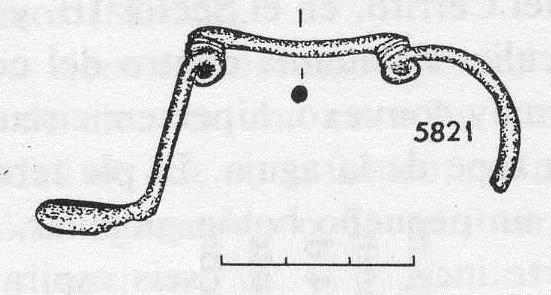
Figure 1. Fibula CS 5213 according to González Prats (1983, 174. fig. 38).
BIBLIOGRAPHY
- ARGENTE, J.L., 1986-87: "Hacia una clasificación tipológica y cronológica de las fíbulas de la Edad del Hierro en la Meseta Norte" (Towards a typological and chronological classification of Iron Age fibulae in the Northern Plateau), Zephyrus, 39-40, 139-157.
- CABRÉ, Mª.E. and MORÁN, J.A., 1977: "Fibulas in the oldest necropolis of the Hispanic Eastern Plateau", Revista de la Universidad Complutense (Homage to García y Bellido, III)XXVI, 109-148.
- GONZÁLEZ PRATS, A., 1983: Archaeological study of the ancient settlement of the Crevillente mountain range., Alicante.
- MALUQUER, J., 1958: The hillfort of Los Castillejos de SanchorrejaÁvila-Salamanca.