

DIGGING IN A CHURCH
Archaeology allows us to learn about past societies through their material remains.
An archaeological site is made up of the remains that exist under the ground as well as those constructions that have survived. All these human works form the tightly woven milestones in the fabric of history. The scenario presented in this room begins 2,400 years ago and continues to the present day.
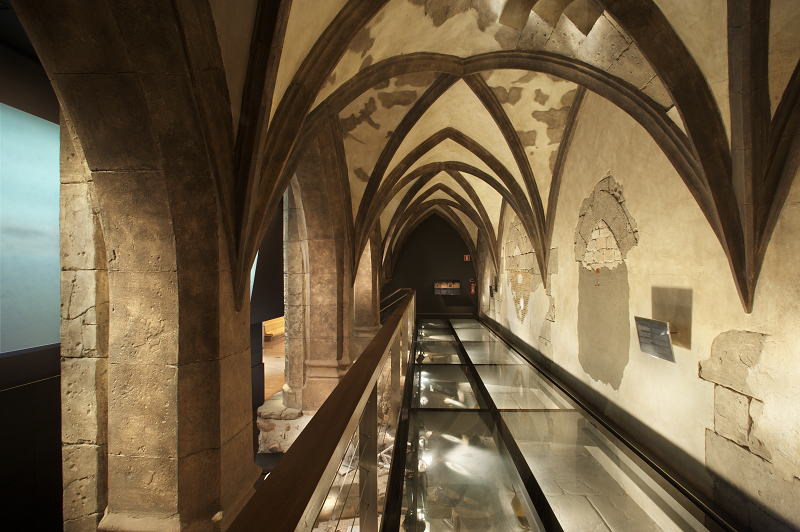
A hypothetical excavation that could have been carried out in an urban environment is shown. In the area of the cloister of a Gothic church or monastery from the 5th century, which shows the constructive parts and different additions, reforms and actions of man throughout its existence, it has been excavated and it has been discovered that it was built on an area that had been inhabited since ancient times.
In the excavated area, the oldest phase, from the 4th century BC, is an Iberian construction attached to a wall located at the end of a settlement, as outside there is a path with traces of tracks cut into the rock. The building remains and artefacts found show evidence of a sudden abandonment caused by a fire at the end of the 3rd century BC or the beginning of the 2nd century BC.
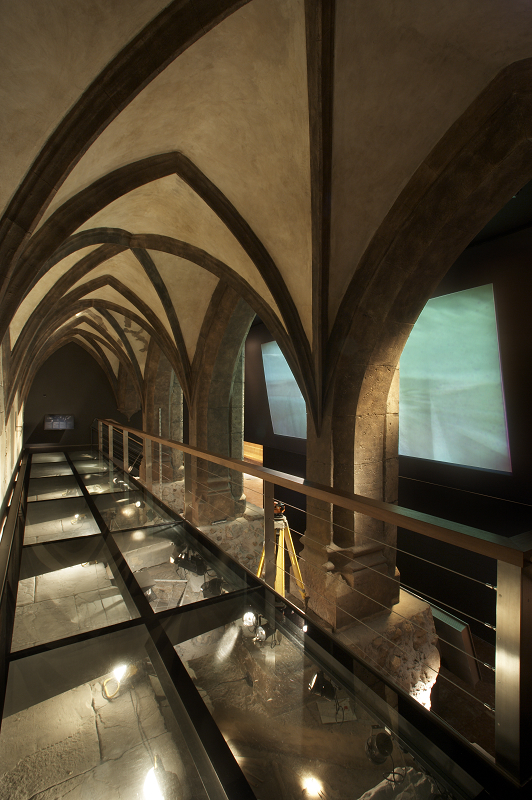
A Roman dwelling from the early 1st century AD was built on top of these ruins, paved with mosaic and with pictorially decorated walls. Only one corner of the villa is visible in the excavated area, and next to it a road, a cistern and a cemetery documented by the funerary inscription. The house was abandoned at the end of the 2nd century, so few artefacts were found.
The ground is levelled on top of the fallen house. In the 5th century the area was used as a cemetery, to which a tomb built with gable roof tiles bears witness. After an unoccupied phase, defined by layers of earth and gravel created by rainwater runoff, in the 12th century the Muslims built another house next to a road in the vicinity of which there is also a cemetery. All that remains of the house is a corner, a drainage system and a cesspit, and of the cemetery, two burial pits.
The house was demolished at the end of the 13th century and the Christian religious building was constructed in the 15th century. In order to create the foundations for the portico of the cloister, deep pits were dug to excavate the remains that preceded it. The portico vault was filled with pots to lighten the weight of the structure. The ashlar walls were subsequently plastered and over time, graffiti and alterations were made to them, such as the modification and bricking up of windows.